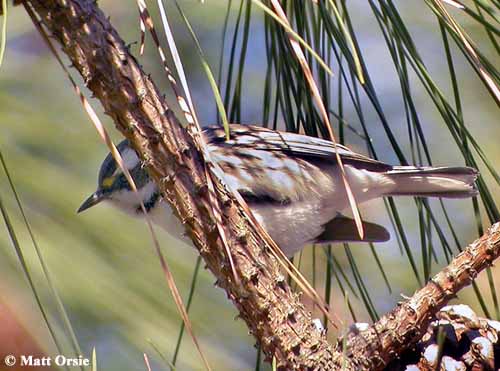
The Black-throated Gray Warbler is normally found in the dry parts of the West. While it is one of the most common "Western" warblers to roam to the eastern half of the country, they are only very rare migrants in South Dakota. Although feeding almost exclusively on insects, they have surprised birders by occasionally stopping at feeding stations for suet, fruit, or peanut butter.
Habitat:
Breeds in dry conifer and mixed woods, especially those of oak, juniper, and pinyon pine, although preferably in second-growth woodland and not mature forest. They can also be found in shrubby thickets in the Southwest.
Diet:
Primarily feeds on insects. Will occasionally come to feeders in migration and in winter for the items mentioned below.
Interactive eBird Map:
Click to access an interactive eBird map of Black-throated Gray Warbler sightings
Song:
The Black-throated Gray Warbler has a distinctive, buzzy song often described as "busy-busy-busy-beaver". This song, typically composed of 5–9 notes, starts rapidly, rises in pitch, and often dips at the end. Males sing this short vocalization to defend territory.
Click here to hear the song of a Black-throated Gray Warbler
Migration:
Summers throughout the southwestern quarter of the United States, and near the Pacific Coast up through southern British Columbia. Winters in the extreme Southwest U.S., Mexico, and Central America.
Similar Species:
Black-and-White Warbler , Blackpoll Warbler. The Black-throated Gray Warbler is distinguished from the Black-and-white Warbler by its gray-streaked back and mostly white throat in females, whereas the Black-and-white Warbler has a striped, zebra-like back and creeps along tree trunks. Compared to the Blackpoll Warbler, the Black-throated Gray has a distinctive dark cheek and a yellow spot in front of the eye rather than the blackpoll's solid black cap, white cheek patch, and orange-yellow legs.
Feeders:
They will occasionally come to feeders in migration for suet, fruit, or peanut butter.
Conservation Status:
The Black-throated Gray Warbler is currently assessed as Least Concern on the IUCN Red List, as it is a common and widespread species with stable populations. While it faces potential threats from habitat loss in certain mature coniferous forests, it is not considered to be in serious danger and is protected under the U.S. Migratory Bird Treaty
Photo Information:
Photo courtesy of Matt Orsie.
