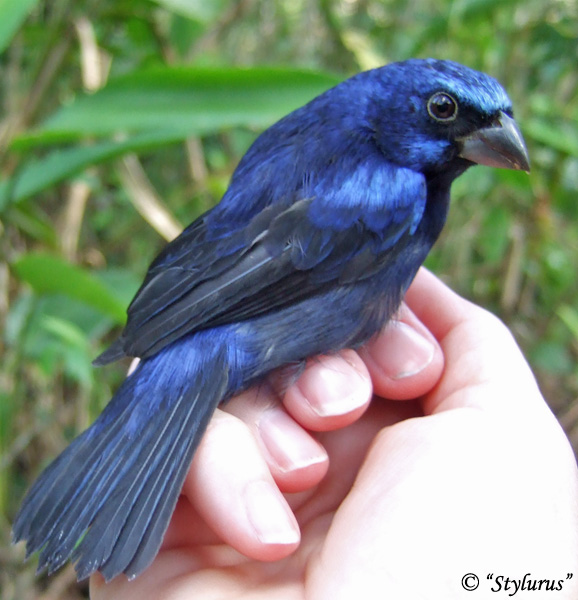
The Blue Bunting is found in brushy thickets and forest edges in many parts of Mexico and Central America. In the U.S., they are but rare visitors, with birds occasionally sighted in southern Texas, and once as far east as Louisiana. Males are a dark blue color overall with brighter blue highlights, while females are a rich reddish-brown overall.
Habitat
Found in brushy fields, woodland edges, and brushy thickets.
Diet
Feeds seeds and insects.
Behavior
Forages in thickets and brush, or low in the forest undergrowth. May also sometimes forage on the ground.
Nesting
The nest is a small cup made of grasses, rootlets, and other vegetative material, placed relatively low to the ground in a bush or small tree. The female lays 2 eggs, with the female incubating the eggs. Both parents help feed the young upon hatching.
Song
Song is a high-pitched warbling of jumbled phrases, tapering off at the end.
Migration
Considered a permanent resident throughout its normal range. However, birds may disperse short distances after breeding, and disturbance of habitat in northern Mexico has been cited as a potential reason for periodic sightings in southern Texas .
Interactive eBird Map
Click to access an interactive eBird map of Blue Bunting sightings
Feeders
Will visit feeders for various seeds, fruit, and suet.
Similar Species
Indigo Bunting , Blue Grosbeak. Blue Grosbeaks are larger (6-7 inches) with heavy, silver-gray bills and rusty-brown wing bars. Indigo Buntings are smaller (5 inches) with smaller, more conical, dark bills and lack prominent wing bars. Blue Buntings are distinct, restricted primarily to tropical regions, with a dark blue, black-masked appearance and a more angled, "hooded" look.
Conservation Status
Populations appear to be stable, and the IUCN lists the Blue Bunting as a species of "Least Concern".
Further Information
Photo Information
Photo taken by " Stylurus " - March 5th, 2009 in Nicaragua - Photo licensed under Creative Commons Attribution NonCommercial ShareAlike 2.0 Generic License .
