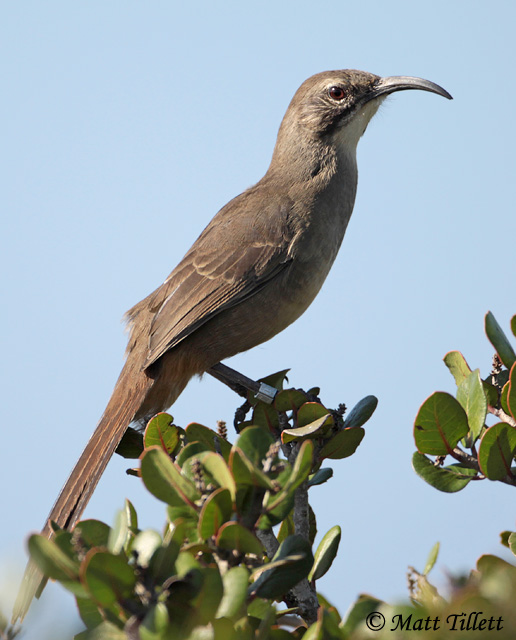
The California Thrasher is common in many parts of their limited range in western and central California, and in Baja California. They are similar in appearance to some of the other western Thrasher species, but the California Thrasher is the only one with a range that includes areas along the coast. Populations have declined in many parts of their range, as conversion of their native habitat to urban uses has resulted in significant habitat loss and fragmentation. However, they are still very common in many parts of their normal range, and populations are not considered seriously threatened or endangered.
Habitat
Found in a variety of lowland, shrubby habitats, including areas of chaparral, riparian thickets, arid shrub, or thickly vegetated suburban areas.
Diet
Feeds on insects and spiders, as well as fruits, berries, seeds, and other plant material.
Behavior
Mostly forages by walking along the ground. They put their thick bill to good use, using it to dig through vegetative litter or digging in the ground.
Nesting
The nest is an open cup of sticks and twigs lined with finer vegetative material, placed in a thick shrub, usually relatively close to the ground. The female lays 3 or 4 eggs, and both parents help to incubate them. After the eggs hatch, both parents help feed and tend to the nestlings. The young leave the nest after about 2 weeks. California Thrashers will often raise more than one brood per year.
Song
The song of a California Thrasher is a series of low-pitched, harsh notes.
Migration
Considered a permanent resident throughout their range, with individual birds rarely moving far from their nesting areas.
Feeders
Will attend feeders for various seeds, fruit, and food scraps.
Similar Species
In range, most likely to be confused with Cristal Thrasher or Le Conte's Thrasher. However, ranges of these species barely overlap, so range alone is typically a good factor for distinguishing the California Thrasher.
Conservation Status
Populations have undoubtedly declined in some areas as urban development and other land-use changes have reduced habitat. However, they are still common in many areas, and the IUCN lists the California Thrasher as a species of "Least Concern" .
Photo Information
Photo taken by Matt Tillett - October 7th, 2011 near San Diego, California - Photo licensed under Creative Commons Attribution 2.0 Generic License .
Interactive eBird Map
Click to access the eBird species page for California Thrasher
