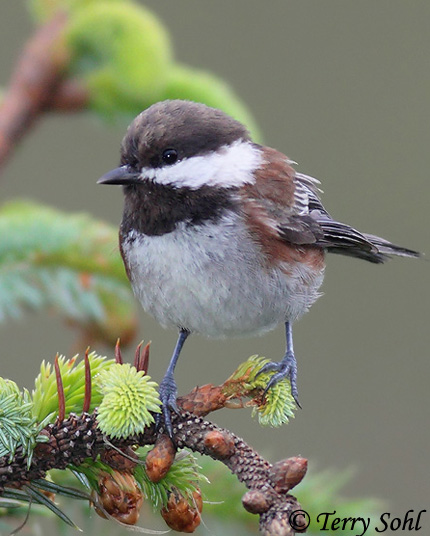
Chestnut-backed Chickadees are among the most colorful of the different chickadee species in North America, and are also the smallest and shortest tailed chickadees. The dark chestnut back is unique for this chickadee, and makes it readily distinguishable from the other chickadee species which overlap in range in the northwestern U.S. and western Canada. In winter, mixed flocks of Chestnut-backed Chickadees, Mountain Chickadees, Red-breasted Nuthatches, Brown Creepers, and Golden-crowned Kinglets can often be seen foraging together in range.
Habitat
In the moist conifer forests of spruce, hemlock, or fir along the Pacific Coast, Chestnut-backed Chickadees are typically the only chickadee species present. They will use dense conifer forests throughout their range, if present. In the southern part of their range, they also will use mixed pine and oak woodlands, and riparian woodlands.
Diet
The Chestnut-backed Chickadee feeds primarily on insects, spiders, and other small arthropods gathered from conifer needles, bark, twigs, and foliage. It also eats seeds, berries, and other plant material, especially during fall and winter, and frequently stores food in bark crevices for later use. Like other chickadees, it readily visits bird feeders for sunflower seeds, suet, and peanuts.
Behavior
Foraging behavior typically includes clambering and hopping from branch to branch in search of insects or other food items. They will often start in the lowest branches of a tree, work their way up, and then move to the bottom of a nearby tree to repeat the process. They will also sometimes act like flycatchers, flying out from a perch to snag insects that are passing by.
Nesting
A cavity nester, primarily nesting in cavities in trees, including old woodpecker holes or nesting holes built by other birds. Will also excavate own cavity in dead and rotting wood. Nesting birds often return to use the same nest hole in subsequent years. Song: Lacks musical song or whistles, with an accelerating series of chip notes functioning as a song. Migration: Generally non-migratory, although birds may move short distances in the fall and winter in search of suitable foraging grounds. Interactive eBird Map:
Song
The Chestnut-backed Chickadee gives familiar chick-a-dee calls, but they are typically faster, huskier, and lower-pitched than those of many other chickadees. Its song is a simple series of clear whistled notes, often rendered as see-see-see, and is generally less elaborate than the songs of Black-capped Chickadee or Carolina Chickadee. Flocks also exchange a variety of soft contact calls, chips, and conversational chatter while foraging through forest canopies.
Migration
The Chestnut-backed Chickadee is largely a permanent resident and does not undertake significant long-distance migration. Most individuals remain year-round within the moist coniferous forests of the Pacific Coast from southern Alaska through California. Some birds may make short seasonal movements to lower elevations during harsh winter weather, but the species is generally considered nonmigratory.
Similar Species
The Chestnut-backed Chickadee is most likely to be confused with the Black-capped Chickadee, Mountain Chickadee, and in parts of the Pacific Northwest, the Boreal Chickadee.
The easiest field mark is the rich chestnut coloration on the flanks and back. Most Chestnut-backed Chickadees show extensive reddish-brown coloration on the sides and often across much of the back, a feature lacking in Black-capped and Mountain Chickadees. Black-capped Chickadee is gray-backed with whitish sides, while Mountain Chickadee is readily identified by its bold white eyebrow stripe.
Boreal Chickadee can show brownish tones, but it has a brown cap rather than a black cap and lacks the rich chestnut flanks typical of Chestnut-backed Chickadee. Boreal Chickadees also tend to inhabit northern boreal forests rather than the moist coastal forests favored by Chestnut-backed Chickadees.
Range is often helpful. Chestnut-backed Chickadees are primarily birds of the Pacific Coast conifer forests from Alaska to California. In contrast, Black-capped Chickadees occupy much of Canada and the northern United States, Mountain Chickadees are birds of western mountain forests, and Boreal Chickadees are found mainly in the boreal forests of Canada and the far northern United States.
Conservation Status
The Chestnut-backed Chickadee is considered a species of low conservation concern, with populations generally stable across its Pacific Coast range. The species remains common in many mature coniferous and mixed forests and adapts reasonably well to parks, wooded suburbs, and second-growth forests. Local declines can occur where extensive forest loss or fragmentation reduces suitable habitat, but overall the species remains widespread and secure. The IUCN considers the Chestnut-backed Chickadee to be a species of "least concern".
Interactive eBird Map
Click to access the interactive eBird species sightings page for Chestnut-backed Chickadee
Top Photo Information
Photo taken by Terry Sohl at Ecola State Park in Oregon.
