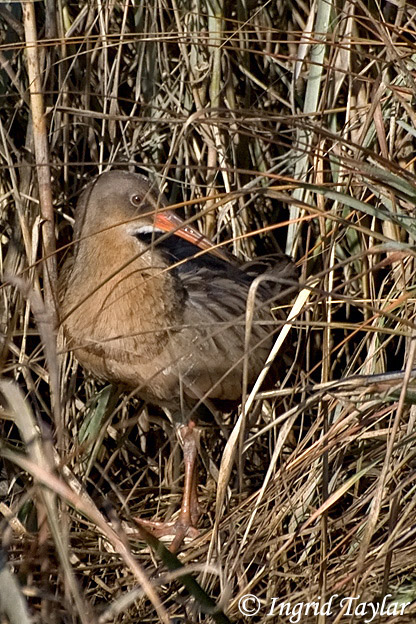
The Clapper Rail is a large rail that is primarily found in salt marshes of the Eastern United States. Scattered populations have also been found along the West Coast, but the species is rare and localized in the West. They are very similar to the King Rail, with which they sometimes interbreed. Some scientists consider the two to be a single species. The two species do differ greatly in habitat preference however, with the Clapper Rail preferring salt-water wetlands and the King Rail preferring fresh water.
Habitat
In much of their range, Clapper Rails are only found on salt marshes. In the southwestern U.S., a subspecies is found in freshwater marsh along the Colorado River, while in Florida, some can be found in mangrove swamps.
Diet
Feeds on a variety of aquatic life depending upon location. Diet may include crustaceans such as crabs or crayfish, mollusks, aquatic insects and their larvae, small fish, or small amphibians. They may also occasionally feed on plant matter, mostly seeds.
Behavior
Clapper Rails forage by walking through the wetland vegetation. Much of the foraging is done at low tide, where they have better access to crustaceans, mollusks, and other food items. Most foraging is done by simply picking up food items when spotted, but they will also occasionally probe in the mud for food with their long bills.
Nesting
The nest of a Clapper Rail is a cup of grasses and other herbaceous vegetation, built in grasses or reeds in a wetland. Both the male and female help to build the nest, and both parents will help to incubate the eggs. Both parents help to raise the young.
Song
The Clapper Rail is famous for its loud, distinctive series of clattering calls that sound like rapidly repeated kek-kek-kek-kek-kek notes accelerating and then slowing, often compared to two pieces of wood being knocked together. Pairs frequently engage in duets, producing a variety of grunts, croaks, cackles, and harsh rattling calls that carry surprisingly far across coastal marshes, especially at dawn and dusk.
Migration
The Clapper Rail is generally a short-distance migrant or year-round resident, depending on location. Many populations along the Atlantic Coast, Gulf Coast, and southeastern United States remain in coastal marshes throughout the year, while birds breeding in the northern part of the range may move southward during winter when marshes freeze. Most movements are relatively local compared to those of long-distance migratory shorebirds and songbirds.
Similar Species
King Rail , Virginia Rail. Compared to the King Rail, the Clapper Rail is generally grayer and duller overall, especially on the back and breast. King Rails typically show richer reddish-brown coloration on the breast and neck, brighter chestnut tones above, and are more often associated with freshwater marshes. Clapper Rails are primarily birds of salt marshes and brackish coastal wetlands, although the two species may overlap in some habitats.
The Virginia Rail is much smaller and shorter-bodied than either Clapper or King Rail. Virginia Rails have a noticeably shorter bill, a gray face and breast, and distinct black-and-white barring on the flanks. Clapper Rails appear much larger, longer-billed, and more elongated in shape.
Habitat is often a valuable clue. Clapper Rail is strongly associated with coastal salt marshes, the King Rail is more typical of freshwater marshes and wet meadows, and the Virginia Rail occurs in a wide variety of freshwater marsh habitats throughout North America.
Conservation Status
Populations in the western U.S. are seriously endangered. Populations in the eastern U.S. have also experienced sharp declines, due to habitat loss. Despite the local reductions in populations, the species is widespread (with populations extending into South America) and populations in North America are locally strong where suitable habitat remains. The IUCN currently lists the Clapper Rail as a species of "Least Concern" .
Photo Information
Photo taken by Ingrid Taylar - November 30th, 2008 - Arrowhead Marsh - Photo licensed under Creative Commons Attribution 2.0 Generic License
Interactive eBird Map
Click to access the interactive eBird species sightings page for Clapper Rail
