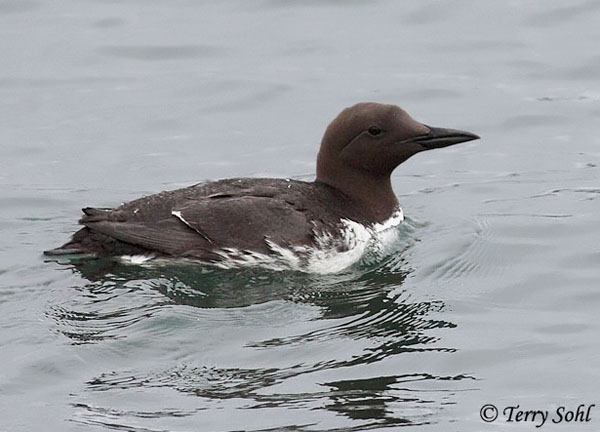
The Common Murre is a large auk with a widespread distribution in North America. They are widespread on the Pacific Coast from Alaska southward to Oregon and California. On the Atlantic Coast they are less abundant and more local, with most found around Labrador and Newfoundland. Common Murres are considered to have the densest nesting colonies for any bird, considering its size. Individual nesting pairs often are typically within touching distance while the birds incubate their single eggs.
Habitat
During the summer breeding season, Common Murres are found on coastal islands and coastal cliffs and rock faces. At other seasons, they are found in cool waters, both close to the coast, and some distance out at sea.
Diet
Mostly feeds on fish, but will also feed on marine worms, squid, and small crustaceans such as amphipods and shrimp.
Behavior
Feeds by diving and swimming underwater, where they may reach depths of up to 150 feet.
Nesting
The nest of a Common Murre is...nothing! The egg is laid directly on a bare rock, typically on a cliff ledge but sometimes on a rock down close to the water. The female only lays one egg each year. Both the male and female help to incubate the egg. Both parents help feed and tend to the young hatchling. After a few weeks, the young is ready to leave the nest, and leaps and glides down to the water's surface, accompanied by the male parent. The male then tends to the young bird until it is able to fly.
Song
Silent most of the time, but on the nesting colony, makes a growling " grrrrrrr" sound.
Migration
They are permanent residents in much of their range. However, birds at the northern edge of their range are migratory (particularly in areas such as western Alaska where coastal waters freeze in winter), and there is some general movement southward on both coasts. Populations also disperse away from coasts in the winter, where they may be found relatively far out to sea.
Similar Species
Thick-billed Murre , Razorbill
Conservation Status
Populations have declined in some locations, but the Common Murre is still common in many areas with a widespread geographic distribution. The IUCN lists the Common Murre as a species of "Least Concern".
Photo Information
Photo taken on June 6th, 2009 - Off the coast of Newport, Oregon - Terry Sohl
Interactive eBird Map
Click to access the eBird species page for Common Murre
