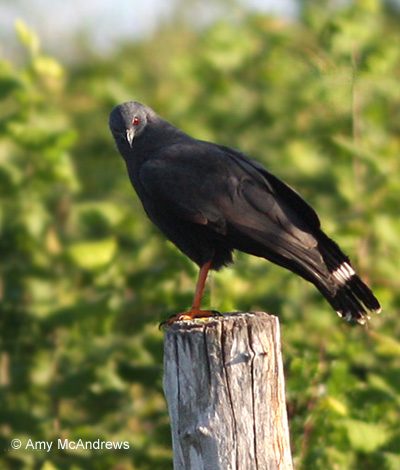
The Crane Hawk is a slim, unusual hawk of the American tropics. They are normally found in Central America and much of South America, as well as part of Mexico. They were unknown in the United States until 1988, when a single Crane Hawk spent the winter in south Texas. Crane Hawks have an unusual structure with very long legs and relatively small feet. While Crane Hawks will hunt by flying and spotting prey, much of their hunting is done by climbing through the forest canopy, reaching into tree cavities or other nooks and crannies with their long legs, and plucking prey from hiding spots that other raptors simply often can't reach.
Habitat
The normal habitat of the Crane Hawk are tropical and sub-tropical forests and forested swamps. They are often found in forested habitats that are near sources of water, including the coast.
Diet
Feeds on a variety of small animals, including frogs, small lizards and snakes, bats, birds and young fledglings, large insects, and small rodents.
Behavior
Most hunting is done by climbing through the forest canopy, using their long legs to grab prey from crevices and cavities. They will also occasionally fly low through the forest as they look for prey.
Nesting
The nest of a Crane Hawk is built in the mid- to upper-parts of the forest canopy. The female incubates the eggs, but both sexes help to raise the young.
Migration
Considered a permanent resident throughout their range.
Similar Species
Somewhat similar to Northern Harrier in overall structure, but distinctive if seen well.
Conservation Status
Crane Hawk populations appear to be slowly declining, likely due to habitat loss. However, the species has a very wide range in the American tropics, and there are currently no perceived major threats to Crane Hawk populations. Birdlife International cites it as a species of "Least Concern".
Photo Information
Photo by Amy McAndrews - December, 2009 - Yucatan, Mexico - Photo licensed under Creative Commons Attribution Non-Commercial No Derivs 2.0 Generic License
Interactive eBird Map
Click to access the eBird species page for Crane Hawk
