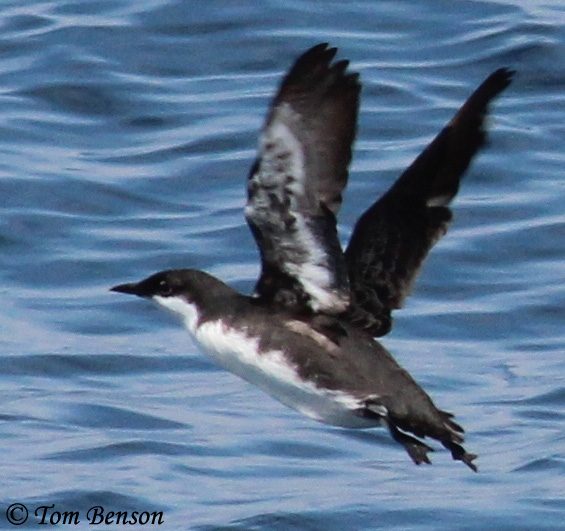
The Craveri's Murrelet is found in a relatively small geographic area, around Baja California at all seasons. They are known in the United States by birds that occasionally move up the Pacific coast after the breeding season, in the late summer. They are very similar in overall appearance to the Scripp's Murrelet and the Guadalupe Murrelet (see notes below). Craveri's Murrelet likely number no more than 10,000, and are considered a "vulnerable" species by the IUCN (see below).
Habitat
During the breeding season, Craveri's Murrelet are found on rocky islands or islands with protected nesting sites like bushes. They can sometimes be found relatively far from the shore when feeding and when not breeding, but more often they are in and around the continental shelf.
Diet
Primarily feeds on small fish
Behavior
Forages by diving under the water's surface, propelling itself with its feet as it chases prey.
Nesting
The Craveri's Murrelet breeds in a small number of island locations around Baja California, in loose colonies. The nesting site is a protected site such as a rocky crevice or the base of a shrub. The female lays 2 eggs directly on the ground, and both parents help to incubate them. The young leave the nest just a day or two after hatching, following the parents to the ocean, where they are raised.
Song
At sea they will occasionally give a high-pitched, rattling trill.
Migration
Craveri's Murrelets nest on a few islands off the west coast of Mexico, and they are found in the same general area at all seasons. However, some birds do move northward along the Pacific Coast in the late summer, where they can sometimes be seen relatively close to shore off the California coast.
Similar Species
Very similar to the Scripp's Murrelet and the Guadalupe Murrelet . On adult birds, Scripp's and Guadalupe Murrelets have white underwings with dark edges, while Craveri's Murrelet underwings are darker and mostly grayish.
Conservation Status
The IUCN lists the Craveri's Murrelet as a "Vulnerable" species , due to a relatively small population, the reliance on a small number of breeding islands, and the introduction of rats and other predators to their breeding sites.
Photo Information
Photo taken by Tom Benson - September 22nd, 2012 - Near Laguna Beach, California - Photo licensed under Creative Commons Attribution NonCommercial NoDerivs 2.0 Generic License.
Interactive eBird Map
Click to access the eBird species page for Craveri's Murrelet
