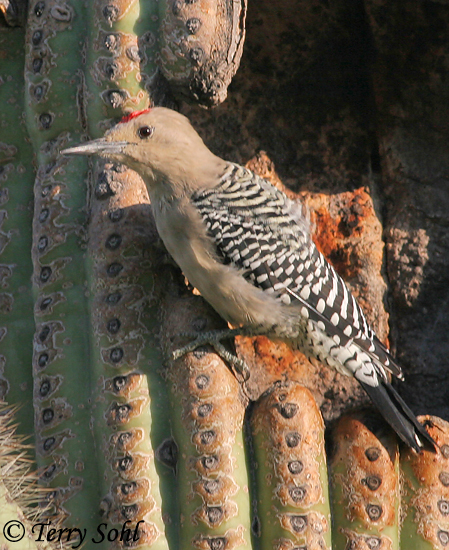
The Gila Woodpecker is a woodpecker of the arid American Southwest. It has a relatively small range in southern Arizona, and western Mexico. There, they are a common, oftentimes loud and obvious, presence in and around human dwellings, as they have adapated well to a human presence in the region. In areas of saguaro cactus in the Sonoran Desert, the saguaro often have cavities created by both Gila Woodpeckers and Gilded Flickers. These cavities serve an important ecological purpose for other species as well, as many other birds use them for nesting.
Habitat
Found in dry habitats in the desert southwest, in and around areas with suitable nesting locations. This includes areas of saguaro cactus, large mesquite trees, or cottonwood trees along desert riparian areas.
Diet
Ominivorous, feeding on a variety of both plant and animal matter. Diet depends on location and season, but may include insects, fruit (especially cactus fruit), berries, nectar, seeds, nuts, small lizards, and eggs.
Behavior
Uses a variety of foraging techniques. Will climb and hop on cactus and trees in search of food, but will also forage directly on the ground.
Nesting
The nest of a Gila Woodpecker is built in a cavity of a tree or cactus. Both parents help to build the nest, and both help to incubate the eggs. Both parents help to raise the young. After fledging from the nest, the young birds will often associate with the parents for several months before becoming completely independent.
Song
The Gila Woodpecker gives loud, rolling churrs, harsh chattering calls, and repeated squeaky notes often described as churr-churr-churr. It is frequently heard calling from the tops of saguaros and desert trees, and both sexes use drumming and vocalizations to defend territories and communicate with mates.
Migration
Considered a permanent resident throughout its range.
Interactive eBird Map
Click here to access an interactive eBird map of Gila Woodpecker sightings
Feeders
Will attend feeders on occasion for nuts and suet. They also will come to hummingbird feeders to feed on sugar water.
Similar Species
Red-bellied Woodpecker, Golden-fronted Woodpecker. The Gila Woodpecker is distinguished by its pale gray-brown head and underparts, black-and-white barred back, and its strong association with desert habitats, especially saguaro cactus country. Compared to the Golden-fronted Woodpecker, the Gila Woodpecker lacks the bright yellow-orange forehead and nape and appears much plainer overall. The Red-bellied Woodpecker has a much more extensive red crown and nape, a pale face, and a faint reddish wash on the belly, features absent in the Gila Woodpecker. Additionally, Gila Woodpeckers commonly nest in large cacti, whereas Golden-fronted and Red-bellied Woodpeckers typically nest in trees.
Conservation Status
Gila Woodpeckers have disappeared from much of their former range in southern California. However, they are still common in southern Arizona, and the IUCN lists the Gila Woodpecker as a species of "Least Concern ".
Further Information
- eBird - Gila Woodpecker
- Audubon Field Guide - Gila Woodpecker
- Cornell Lab of Ornithology - All About Birds: Gila Woodpecker
Photo Information
Photo taken on September 10th, 2006 - Near Tucson, Arizona - Terry Sohl
