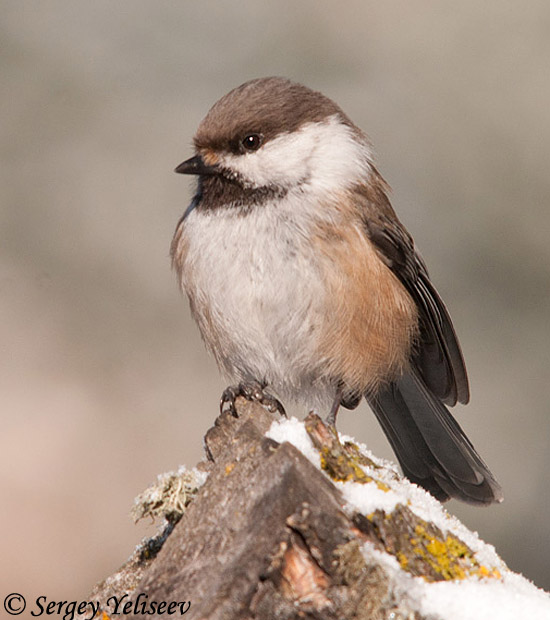
The Gray-headed Chickadee is the only member of the family that is found in both the Old World and New World. In Europe and Asia, they are found from Scandinavia, eastward across northern Europe and Asia. They are better known as the "Siberian Tit" in their Eurasian range. In North America, their geographic range is remote and populations are relatively small. They are a prize species for birders in North America, a bird that most birders will never see.
Habitat
In their limited North American range, the Gray-headed Chickadee is found in stunted spruce forest, near treeline.
Diet
Feeds on insects, insect larvae, spiders, seeds, and nuts.
Behavior
Forages by clambering and flitting through the tree foliage in search of food. They may also fly out to grab insects from mid-air.
Nesting
The nest is in a cavity in a tree, either a natural cavity or an old woodpecker hole. The cavity is lined with bits of soft decaying wood, lichens, moss, and animal hair. The female lays between 6 and 9 eggs, and she alone incubates them. When the eggs hatch, both parents help feed the young. The young leave the nest after about 3 weeks.
Song
The song of Gray-headed Chickadees in North America isn't well known, but the song of the species in Eurasia is a series of rapid " che-ow " notes.
Migration
Considered a permanent resident throughout its normal range.
Interactive eBird Map
Click here to access an interactive eBird map of Gray-headed Chickadee sightings
Similar Species
Black-capped Chickadee , Boreal Chickadee
Feeders
In their Eurasian range, Gray-headed Chickadees will occasionally visit feeders for various seeds, nuts, and suet. Their range in North America is remote, with very low human populations, so feeder attendance in North America is unknown.
Conservation Status
Global populations are generally stable, and the species is found over a wide geographic region. The IUCN lists the Gray-headed Chickadee as a species of "Least Concern".
Further Information
- eBird - Gray-headed Chickadee
- Audubon Field Guide - Gray-headed Chickadee
- Cornell Lab of Ornithology - All About Birds: Gray-headed Chickadee
2) Audubon Guide - Gray-headed Chickadee
3) Whatbird - Gray-headed Chickadee
Photo Information
Photo taken by Sergey Yeliseev - June 12th, 2012 - Republic of Altai in Russia - Photo licensed under Creative Commons Attribution NonCommercial NoDerivs 2.0 Generic License.
