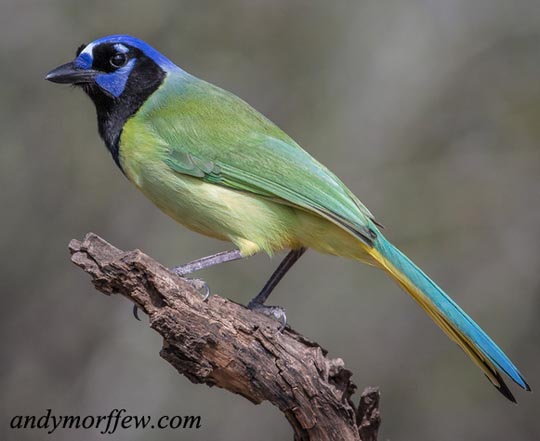
The Green Jay is an unmistakable species that is relatively common in Mexico and elsewhere in Latin America, but was unknown in the United States until they started appearing in southern Texas in the 1970s. They are still only found in the far southern part of Texas, but their range and numbers appear to be expanding in recent decades. There is some debate as to whether there should actually be two different species of Green Jay. Populations in the U.S., Mexico, and Central America are geographically separated from populations found in South America, and there are also differences in plumage and habits.
Habitat
Green Jays in the United States are most often found in dense forests along the Rio Grande river. In the rest of their range, they can be found in a variety of woodland habitats, typically in more open woodlands or along woodland edges and clearings.
Diet
Omnivorous, feeding on a wide variety of items, including insects and spiders, small lizards, snakes, and amphibians, small rodents, bird eggs and young nestlings, fruits, berries, nuts, and sometimes human refuse.
Behavior
Green Jays are often gregarious, foraging in flocks. They will use a variety of foraging techniques, depending upon locality and what food items are available. Very opportunistic.
Nesting
Green Jays have rather complicating nesting and breeding patterns. Typically, for birds in the U.S., a small breeding colony has one nest with one breeding pair of birds. The previous year's brood stays with the breeding parents and helps to defend the territory and raise the young. Nest building itself is also often communal, with multiple members of the flock helping to construct the nest, a crudely built cup of sticks, twigs, leaves, and soft plant material.
Song
Variable series of calls, often harsh croaking or other shrill calls.
Migration
Non-migratory, considered a permanent resident throughout their range.
Interactive eBird Map
Click here to access an interactive eBird map of Green Jay sightings
Feeders
Green Jays will occasionally use feeders stocked with fruit, nuts, and some human table food.
Similar Species
Unlikely to be confused with other bird species
Conservation Status
There are no major conservation concerns at this time. The IUCN lists the Green Jay as a species of "Least Concern".
Further Information
- eBird - Green Jay
- Audubon Field Guide - Green Jay
- Cornell Lab of Ornithology - All About Birds: Green Jay
2) U.S. Geological Survey's Bird InfoCenter- Green Jay
3) WhatBird - Green Jay
Image Information
Photo by Andy Morffew - Photo licensed under Creative Commons Attribution NoDerivs 2.0 Generic license.
