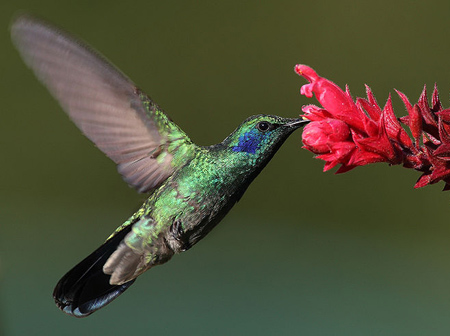
The Mexican Violetear is typically found in central Mexico, Central America, and northern South America. While mostly a permanent resident throughout its normal range, individuals seem to wander widely. Mexican Violetears are found in Texas seemingly every year, and individual birds have strayed as far north as Wisconsin, Michigan, and even Canada.
Habitat
In their normal range in Mexico, Central America, and South America, Mexican Violetears are typically found in montane forest clearings and forest edges. They can be found at elevations as high as 10,000 feet on the eastern slope of the Andes in South America. Those that have been wandered to the U.S. have typically been found in urban and suburban habitats when they frequent bird feeders.
Diet
Typical diet of Hummingbirds, feeding heavily on nectar. Insects can comprise a large portion of the diet.
Behavior
Mexican Violetears will defend a feeding territory like other hummingbirds, but in their normal range, they are often dominated by other hummingbird species. They are typically solitary, but can be found in loose concentrations where adequate food supplies are present.
Nesting
The nest of the Mexican Violetear is usually built fairly low to the ground on the horizontal branch of a shrub or tree, from 3 to 12 feet high. The nest is built of plant fibers, tiny twigs, moss, and "decorated" with lichens. The female alone builds the nest, incubates the eggs, and raises the young.
Song
Song of the Mexican Violetear is a series of high tinkling chip notes..
Migration
Some birds in the northern part of the range are migratory, moving southward in the late summer. However, most birds throughout their range are permanent residents.
Interactive eBird Map
Click here to access an interactive eBird map of Mexican Violetear sightings
Feeders
Will attend hummingbird feeders
Similar Species
Somewhat similar overall coloring to Broad-billed Hummingbird
Conservation Status
At present, populations of the Green Violet-ear seem relatively stable. The species' preference for shrubby and disturbed habitat makes it less susceptible to human activity than many other species, and it may actually benefit from forest disturbance activities.
Further Information
- eBird - Mexican Violetear
- Audubon Field Guide - Mexican Violetear
- Cornell Lab of Ornithology - All About Birds: Mexican Violetear
2) WhatBird.com - Mexican Violetear
3) HummingbirdsUSA.com - Mexican Violetear
Photo Information
Taken in Boquete, Panama - Licensed under Creative Commons Attribution-ShareAlike 3.0 Unported license .
