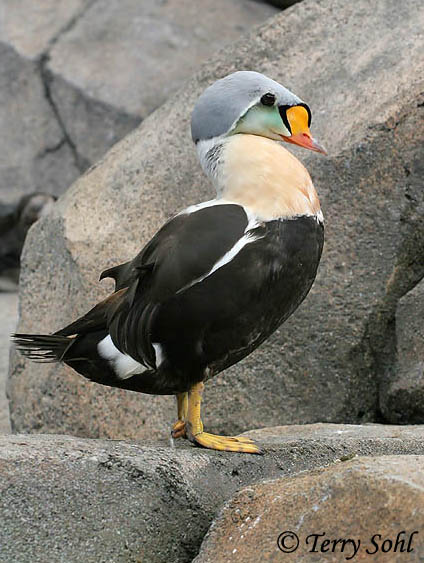
ID Keys: Adult breeding males unmistakable. Non-breeding males
dark brown overall with orange bill. Females tan with dark
"chevron" markings on flanks
The
King Eider is a uniquely patterned sea-duck of the far northern extremes of
North America. They are strongly tied to salt-water habitats in most
seasons, although they can be found on inland freshwater lakes of the far
north during the summer breeding season. They are gregarious and often found
in very large flocks, with flocks in migration sometimes exceeding 10,000
individual birds.
Habitat
During the summer breeding season, they
are found on high Arctic tundra in extreme northern Alaska and Canada.
In winter, they are found a bit further south along the coasts or around the
edge of pack ice.
Diet
Feeds mostly on mollusks, but depending on
season and location, they will also feed on crustaceans, aquatic insects and
larvae, and occasionally plant material.
Behavior
King Eiders are excellent divers, and
obtain most of their food by diving underwater, sometimes to depths of up to
100 feet or more.
Nesting
The nest is on a raised patch of ground
near water, and is usually just a depression lined with down and vegetation.
The female alone incubates the eggs. The young feed themselves upon
hatching and leaving the nest, but the female will tend to them and protect
them.
Song
During courtship, the male gives a low
pitched moaning call that rises in pitch toward the end.
Migration
Summers throughout much of the high
Arctic, where it is often found in relatively large numbers. In winter,
moves southward along both costs of North America. Migration is
typically along the coasts, as the species is only very rarely found inland.
Males are distinctive in breeding plumage. Non-breeding males could
possibly be confused with other eiders, but even the relatively drab
non-breeding males are distinctive from other non-breeding eider males.
Females may possibly be confused with a relatively large number of duck
species.