
Very similar to its close relative, the Short-billed Dowitcher, with only a slightly longer bill. Major differences lie in their different voices and their habitat preference, as the Long-billed Dowitcher prefers freshwater, while the Short-billed Dowitcher is more often found in saltwater. The photo at the right shows a breeding plumage bird. Photos below also show a winter-plumaged bird.
In South Dakota Long-billed Dowitchers are migrants, seen in both the fall and spring seasons. However, given how quickly many birds leave their northern Arctic breeding grounds, Long-billed Dowitchers may be seen almost any month in South Dakota, from April through October.
Habitat
Mudflats, flooded fields and pastures, marshes, sloughs, and shallow ponds.
Diet
Variety of items depending on location and season. Will feed on insects and insect larvae, mollusks, crustaceans, and seeds of aquatic and terrestrial plants.
Behavior
Forages deliberately in shallow water, probing in the bottom mud with its bill.
Breeding
Non-breeder in South Dakota, as their breeding grounds are in far northwestern Canada and the north slope of Alaska. The nest of a Long-billed Dowitcher is built on the tundra, usually next to a pond, and placed on or next to a small clump of tundra grasses. The nest is a cup-shaped depression, lined with grasses and other tundra vegetation. The female lays 3 or 4 eggs, and both parents help to incubate them. The young hatch after about 21 days. Once the young hatch, they leave the nest almost immediately, and must feed themselves. The male will stay near the young and attempt to protect them from danger.
Song
Vocalizations of Long-billed Dowitchers are primarily heard when they birds are threatened or flush upon approach. They may be short, individual peep notes, or a chattering series of similar notes. A complex chattering call is also given on the breeding grounds by the males.
- Click here to hear short individual notes and a chattering call of a Long-billed Dowitcher1
- Click here to hear the complex song of a male Long-billed Dowitcher on its breeding grounds2
Migration
Summers in extreme northern Alaska and northwestern Canada. Winters along U.S. coasts, Mexico, and Central America. In South Dakota, they are common migrants, found in both the spring and fall migration. Given how quickly some birds return from their northern breeding grounds, birds can be seen at almost any time from April through October in South Dakota, although the month of June appears to be the one time period where most birds are still on their breeding grounds.
Interactive eBird Map
Click here to access an interactive eBird map of Long-billed Dowitcher sightings
Similar Species
Long-billed Dowitchers have one very close relative that can also be found in South Dakota, and there are other shorebirds that could potentially be confused with them. Here are the species most likely to be confused with a Long-billed Dowitcher:
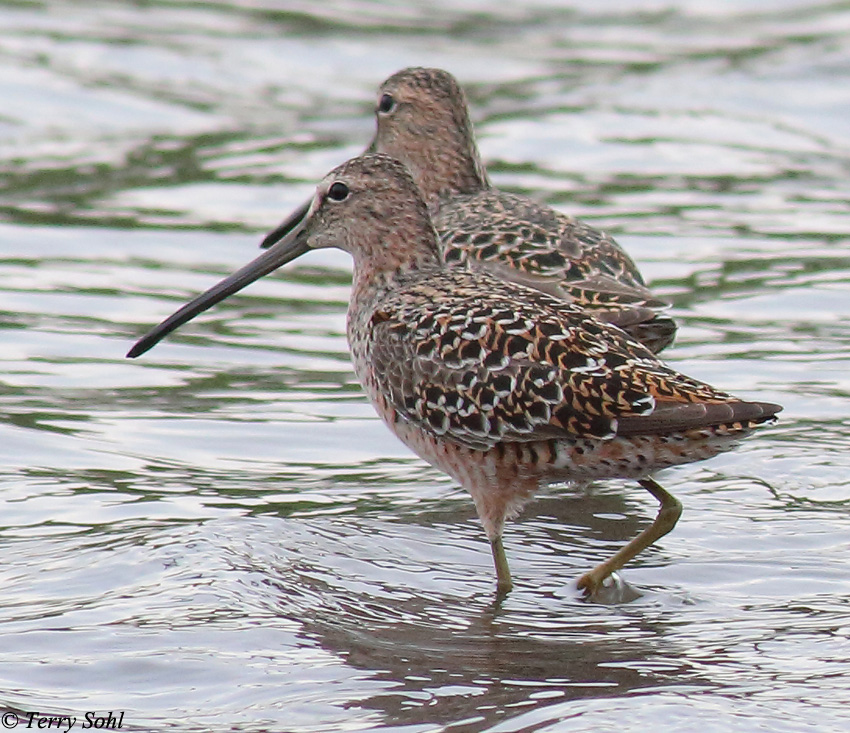
- Short-billed Dowitcher
- One of the most difficult pair of birds to differentiate can be
Short-billed vs. Long-billed Dowitcher. Long-billed Dowitchers are
undoubtedly the most common of the two species in the state, and when in
doubt, a default label of a Long-billed Dowitcher isn't a bad strategy.
While both species can be found in the state in migration, Short-billed
Dowitchers are much more likely to migrate along the coasts rather than
through the interior of the country.
In terms of differentiating between the two species, there are a number of subtle clues, but none are greatly obvious when seeing birds in the field. In general look for the following to differentiate a Short-billed from a Long-billed Dowitcher:- Bill Droop - Supposedly, Short-billed Dowitchers are more likely to have a slight droop in the last third of the bill.
- Leg length - It's not something you'll notice in a bird that's isolated from the other species, but if the two are wading side-by-side, the Short-billed Dowitcher appears to have shorter legs than a Long-billed Dowitcher
- Supercillium - The arched "eyebrow" that's often visible on both species is often slightly more curved on a Short-billed Dowitcher, and straighter on a Long-billed Dowitcher
- Primary Feather Projection - The long primary flight feathers on a Short-billed Dowitcher generally extend just to, or just past the tip of the tail. On a Long-billed Dowitcher, the primary feathers tend to stop just short of the tip of the tail.
- Lower back - One source notes a Short-billed Dowitcher tends to have a straighter shape along the entire back, while a Long-billed Dowitcher's back appears "indented" right at the base of the tail.
- Covert feathering - The feathers that cover the flight feathers of a bird at rest have a white edging towards the tip. On a Short-billed Dowitcher, that white edging can extend upward along the edge of a given feather as well, giving the white more of a "V"-shaped appearance than the Long-billed Dowitcher, where the white is restricted to more of the bottom of the feather. This too can be a difficult ID mark, as it's only obvious in freshly plumaged birds, and is less reliable as breeding plumage is worn and tattered.
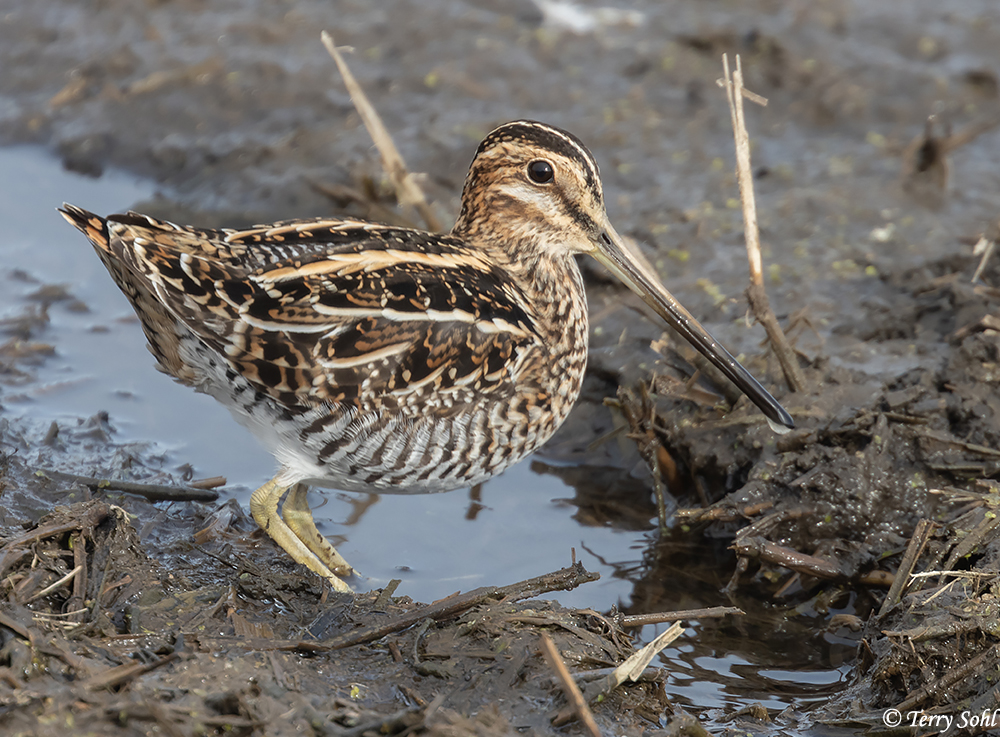
- Wilson's Snipe - Wilson's Snipe are a common migrant and summer resident in South Dakota. They share the same stocky build and long bill of a Long-billed Dowitcher. Plumage is substantially different, particularly in breeding plumage when the Long-billed Dowitcher has rich ruddy colors on the underparts, compared to the whiter belly on a Wilson's Snipe. Wilson's Snipe also have a stronger facial pattern with apparent stripes, and an eye that seems larger in proportion to the head than a Long-billed Dowitcher.
 |
 |
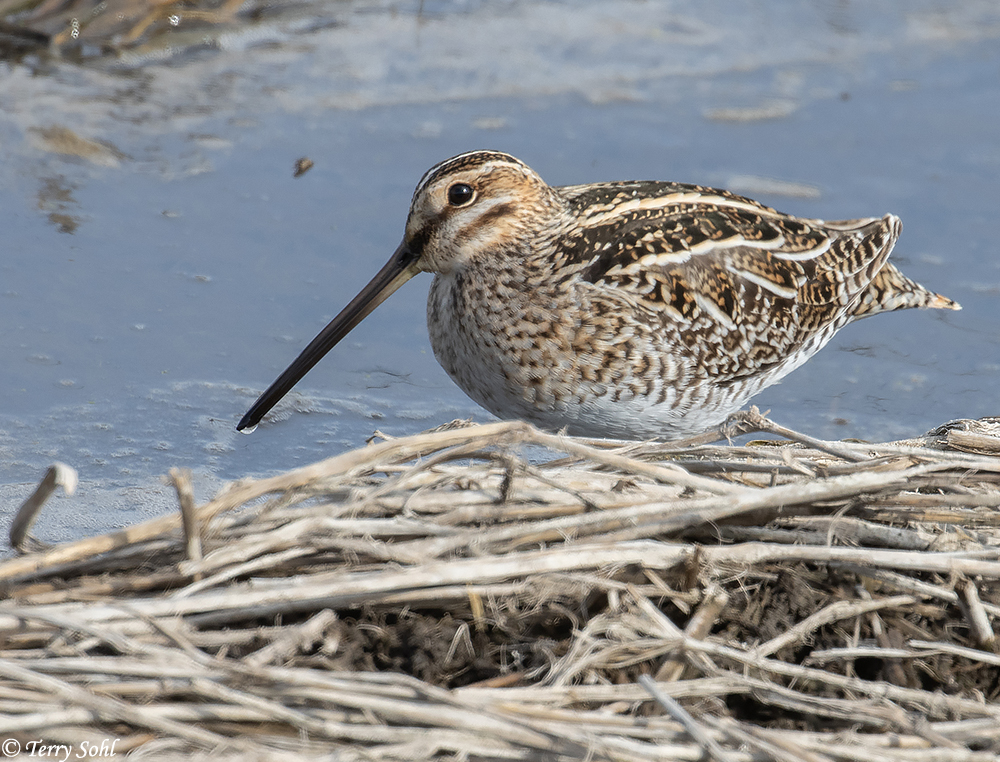 |
| Short-billed Dowitcher | Wilson's Snipe | Wilson's Snipe |
Conservation Status
Long-billed Dowitchers have a very broad geographic range, overall populations appear to be relatively stable, and they are common in parts of their range. The IUCN considers the Long-billed Dowitcher to be a species of "Least Concern".
Photo Information
May 14th, 2010 -- Lake Whitewood -- Terry Sohl
Audio File Credits
- 1Manuel Grosselet. Recorded in Sinaloa, Mexico on August 3rd, 2019. Original recording and information available from xeno-canto.
- 2Patrick Aberg. Recorded near Barrow, Alaska on June 10th, 2017. Original recording and information available from xeno-canto.
