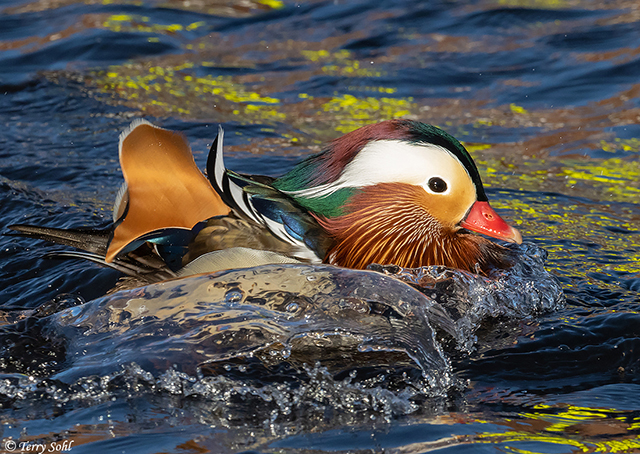
The Mandarin Duck is an extremely colorful small dabbling duck with a native range in eastern Asia, including most of the Japanese Islands, eastern China, and southeast Asia. There they are birds of woodland and forest lakes, using nesting cavities in the trees for breeding while foraging in nearby lakes and rivers.
With their unique, colorful plumage, Mandarin Ducks have sometimes been popular birds to raise in captivity. Escapees have established strong, permanent breeding populations in parts of western Europe. Similarly, there are now small permanent, free-flying and reproducing populations in parts of the United States, particularly in California.
Despite the establishment of breeding populations in parts of the US, sightings of the species in most of the US are generally considered to be of escaped birds, although free-flying and wild birds cannot be completely discounted. In South Dakota, a lone male Mandarin Duck was found in a small urban park in Yankton in the fall of 2020 (photo to the right and those below). Likely one of the most seen and photographed individual birds to ever be seen in South Dakota, the colorful drake spent several weeks at the park, in the companionship of a male Wood Duck. The two were inseparable, following each other and even defending territory from other waterfowl on the park's small pond. Unfortunately, the Mandarin Duck disappeared in December 2020, with feathered remains near the pond suggesting it was captured by a predator.
Habitat
In its native habitat in eastern Asia, Mandarin Ducks prefer woodland and forest edges adjacent to water bodies, with access to both nesting cavities for breeding, and foraging areas in the adjacent aquatic habitat. Introduced and feral populations in western Europe and North America are more likely to use more open marshland and wetland habitats than their counterparts in eastern Asia.
They are found in freshwater habitats during the summer breeding season, but will also use protected coastal marshes and bays during the winter months.
Diet
Omnivorous, eating a wide variety of food items, but with vegetative material often making up the majority of the diet. The diet may include seeds, plant shoots and roots, insects, small crustaceans and mollusks, and occasionally small fish or amphibians.
Behavior
Foraging primarily occurs early or late in the day, with daylight hours used to roost in a tree or in a semi-protected location on the ground near water. Foraging is done by dabbling from the water's surface, or by walking on the shoreline near water.
Nesting
Like their North American relatives the Wood Duck, Mandarin Ducks are cavity nesters, selecting a natural cavity (or cavity made by another creature) in a tree close to water. The female lays between 8 and 12 eggs, and she alone incubates the eggs. The male generally departs before the eggs hatch, leaving the female to tend to the young. Incubation lasts about 4 weeks, with the young leaving the nest within a day of hatching. The female leads the young to water and protects them, but the young feed themselves. The young won't gain flight ability for several weeks after hatching.
Song
Male Mandarin Ducks have a thin, repeated rising whistling call. Females have multiple short (and often harsh) call notes. Flight and alarm calls are a repeated, loud series of ku-whack notes.
1Click here to hear the whistling calls of a male Mandarin Duck
2Click here to hear flight calls of a flushed Mandarin Duck
3Click here to hear a short, harsh call of a female Mandarin Duck
Migration
Generally considered to be permanent residents in much of their normal range in eastern Asia. However, they will sometimes gather in larger flocks in the winter months, even eschewing their normal freshwater habitats for coastal saltwater habitats.
Interactive eBird map
Click here to access an interactive eBird map of Mandarin Duck sightings
Similar Species
Males are unmistakable and unlikely to be confused with any other species. Female Mandarin Ducks share similarities with female Wood Ducks.
Conservation Status
Populations of Mandarin Duck in their native range in east Asia have undoubtedly declined in the 20th and 21st centuries. However, they are still found in a relatively broad geographic area and are common in parts of their range. They also have growing established populations in western Europe, and some small populations established in North America. Thus, despite the declines, overall numbers are strong enough that the IUCN considers the Mandarin Duck to be a species of "Least Concern".
Photo Information
November 15th, 2020 -- Yankton, South Dakota -- Terry L. Sohl
