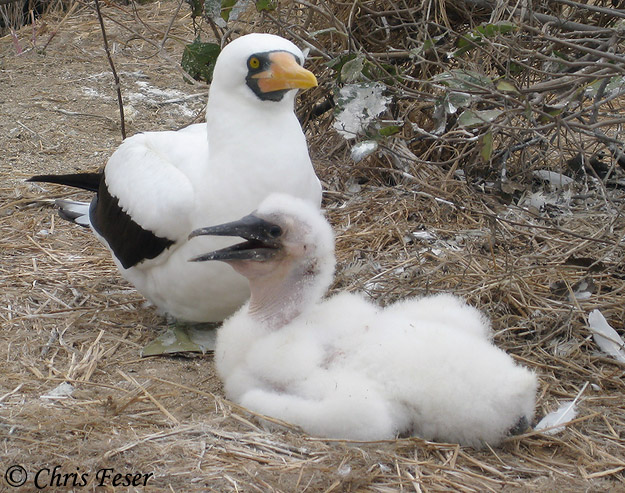
ID Keys: Adults white overall with black wing coverts and tail.
Juveniles dark above and white below.
The
Masked Booby is another Booby species with a wide geographic range, as they
are found throughout much of the tropical warm waters of the Pacific Ocean,
as well as in the western Atlantic Ocean. While they have always been
known to nest in many locations in the Caribbean, they were unknown as
breeding birds in the continental United States until nesting attempts began
on the Dry Tortugas in Florida in the 1980s. They also can be found
nesting in the Hawaiian Islands. A very similar species, the Nazca
Booby, was recently recognized as a separate species. The Nazca Booby
is found as a breeding bird off the northern coast of South America,
including the Galapagos Islands.
Habitat
Nesting occurs on tropical islands,
usually those with low topography and a lack of large trees and shrubs.
Outside of the breeding season, they can be found anywhere from areas close
to shore, to far out to sea.
Diet
Feeds mostly on fish, but will also feed on
squid.
Behavior
Forages by plunge diving, or by swimming
on the ocean's surface and reaching down to grab prey when spotted.
Nesting
The nest of a Masked Booby is a simple
shallow scrape on the ground, sometimes surrounded by a rim of pebbles,
sticks, or other small bits of debris. The female lays one or two
eggs, and both parents help to incubate them. Upon hatching, both
parents help to feed the young. The young are fed by parents until
they are 4 or 5 months old.
Song
At breeding colonies, young and female birds
have a harsh honking call. Males have a thin whistling call.
Away from breeding colonies, Masked Boobies are usually silent.
Migration
There are no clear migration patterns
for Masked Boobies, but individual birds do often disperse widely from
breeding colonies after the breeding season.