
The Neotropic Cormorant is very similar to the Double-Crested Cormorant, and is sometimes found with them. Neotropic Cormorants are found throughout the American Tropics up through Texas, but have been expanding their range northward in recent decades, with breeding now frequent in parts of Texas, Arizona, New Mexico, and Louisiana. In South Dakota they are rare visitors, but Neotropic Cormorants are increasingly found as scattered vagrants throughout many parts of the United States.
They are formerly known as the Olivaceous Cormorant.
Habitat
Neotropic Cormorants are found both in coastal waters and inland fresh water or brackish water. They may be found in a wide variety of habitats, particularly outside of the breeding season. They tend to hunt shallower waters than some other cormorant species.
Diet
Neotropic Cormorants mostly feed on small fish, but are opportunistic and will take other vertebrates and invertebrates if the opportunity arises. This may include frogs, tadpoles, insects, and crustaceans.
Behavior
Neotropic Comorants primarily forages by diving from the surface and swimming underwater after prey, propelled by its feet. Groups of the species sometimes forage cooperative, driving fish into shallow water. It's not a common behavior, but Neotropic Cormorants are the only cormorant species known to also plunge dive, spotting prey while in flight and then plunging down into the water bill first in an attempt to capture it.
As with other cormorant species, Neotropic Cormorants are sometimes seen sunning themselves with their wings spread. As they dry their plumage, they also often preen, spread oil from a gland near the tail throughout their feathers.
Breeding
Non-breeder in South Dakota. In their breeding range, Neotropic Cormorant males first scout out nesting sites, and then attempt to attract a mate by spreading its wings, calling, and swaying. Once a couple bonds, they collaborate to build a nest, with males gathering and delivering nesting material, and the female using those materials to actually construct the nest. The nest is a loose platform of sticks, lined with smaller material such as leaves, grasses, weed stems, feathers, and sometimes whatever man-made material they happen to come across. The female lays 2 to 6 eggs, and both parents help to incubate them. The young hatch after about 24 days, with both parents helping to raise them.
Song
Neotropic Cormorants are often silent outside of the breeding season, but do have the capability to make grunting and croaking sounds. Males will call from a perch near a "proposed" nesting site to try to attract a mate.
- Click here to hear the grunting calls of a Neotropic Cormorant1
- Click here to hear the combined calls of several Neotropic Cormorants at a breeding colony2
Migration
Neotropic Cormorants are generally considered a permanent resident throughout its range. Normally found in the extreme southern U.S. and Mexico, the Neotropic Cormorant is expanding its range northward, but is still a very rare visitor to South Dakota. In newly expanded breeding areas, it may be only a summer resident, moving southward short distances for the winter.
Interactive eBird Map
Click here to access an interactive eBird map of Neotropic Cormorant sightings
Similar Species
Neotropic Cormorants are only likely to be confused with one species in South Dakota, but in other parts of their range could potentially be confused with other species as well.
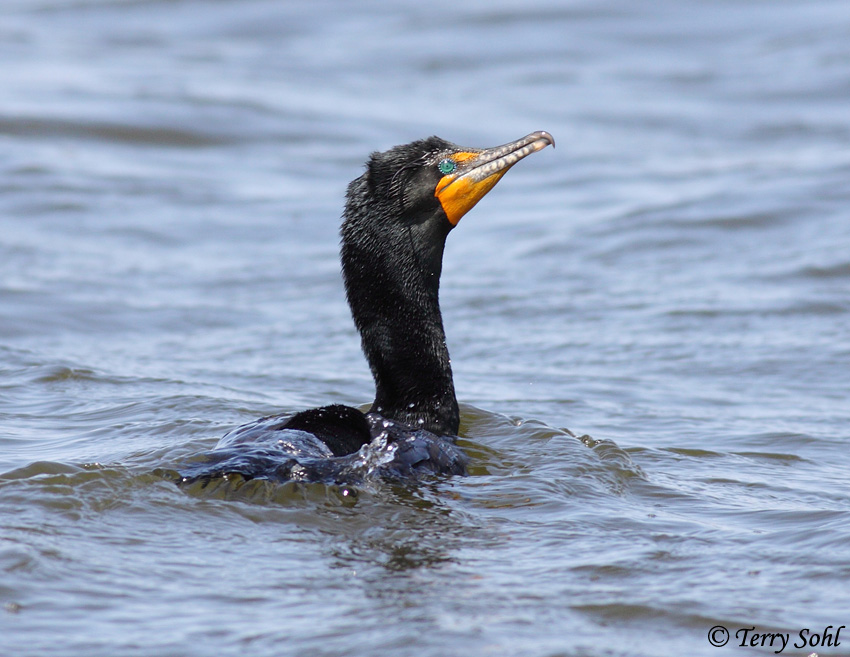
- Double-crested Cormorant - In South Dakota, Double-crested Cormorants are very common, and any cormorant seen in the state should be assumed to be this species. However, Neotropic Cormorants have appeared from time to time. The two species can be differentiated by size, as Double-crested Cormorants are larger (a difference that may only be obvious if the two species are side-by-side). The other identification key can be difficult to distinguish at distance, but the orange around the base of the bill (gular patch) is different in extent and shape. On a Double-crested Cormorant, there's a more extensive patch of orange, from beneath the eye as well as above the bill and in front of the eye. On a Neotropic Cormorant, the orange is only found below the eye, terminates in a distinct "V" shape at the base of the bill, and has a thin boundary of white between the black head feathering and the orange gular patch.
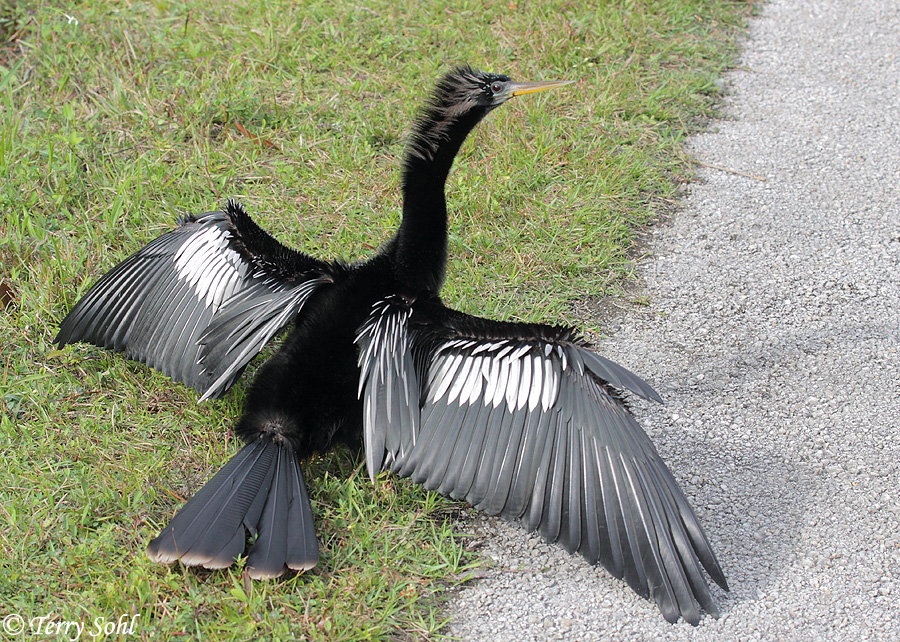
- Anhinga - Not an issue in South Dakota, but in coastal Texas and Louisiana, Anhinga and Neotropic Cormorants come into contact. Anhingas are a larger bird than a Neotropical Cormorant, with a longer bill that terminates in a sharp point, rather than the hooked appearance of a Neotropic Cormorant. Anhinga lack the orange gular patch of a Neotropic Cormorant. Male Anhinga have white feather edging on their back, and female Anhinga have a pale head and neck with a sharp demarcation to a darker body below. Compare those patterns to body plumage of a Neotropic Cormorant which is uniformly black.
 |
 |
 |
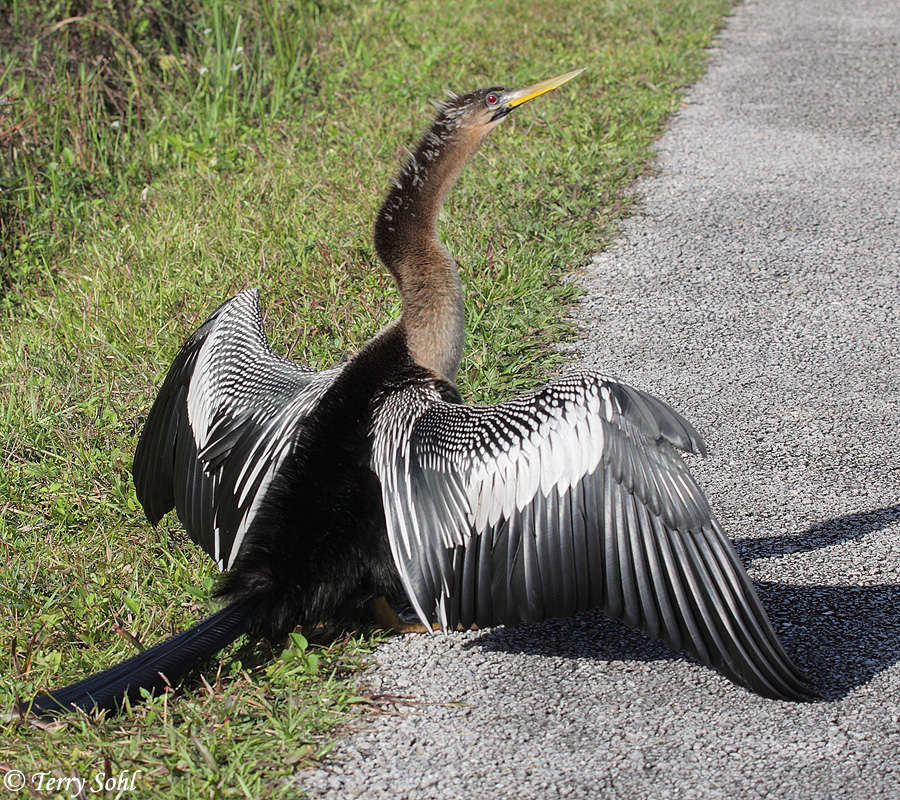 |
| Double-crested Cormorant | Double-crested Cormorant | Anhinga (male) | Anhinga (female) |
Conservation Status
Populations of Neotropic Cormorants had declined sharply by the mid-20th century, but have been recovering since that time. Systematic surveys in recent decades show both increases in overall populations, and an expansion of range to the north. They are found across a broad geographic area, are common in parts of that range, and overall populations are strong. The IUCN considers the Neotropic Cormorant to be a species of "Least Concern ".Photo Information
December 28th, 2018 - Gilbert Water Ranch, Phoenix, Arizona - Terry Sohl
Audio File Credits
- 1Paul Marvin. Recorded at the Gilbert Water Ranch in Phoenix, Arizona on January 12th, 2018. Original recording and information available from xeno-canto.
- 2Chris Benesh. Recorded in Oaxaca, Mexico on January 5th, 2010. Original recording and information available from xeno-canto.
