
The Northern Shoveler are a widespread dabbling duck species found not only in North America, but also in Europe, Asia, and Africa. A large duck with bold plumage patterns on a male, it's their unique spatulate bill that makes the species stand out. Northern Shovelers use that large flattened bill to strain water for small aquatic plants and animals, as the bill has comb-like structures along the edge for filtering. They are one of the most common duck species in South Dakota, breeding throughout the state and found in large numbers in migration as well.
Habitat
Ponds, lakes, and marshes. In the summer breeding season in the state, they nest in upland habitats, usually short grass areas with shallow water nearby. During migration and in winter they will use a wider variety of habitats, including brackish and near coastal waters.
Diet
Omnivorous. Summer eats mix of aquatic plants, grasses, insects, crustaceans, small fish, and seeds. Winter diet is primarily seeds and plant material.
Behavior
Forages by swimming slowly with bill submerged just below the surface. Food items are gathered by filtering water through the unique bill. Unlike some other dabbling ducks, they rarely will feed on land.
Nesting
May through July. The nest of a Northern Shoveler is a shallow depression on the ground, lined with grasses and weeds with an inner layer of down. The female usually lays 8 to 12 eggs, and she alone incubates them. The young leave the nest soon after hatching, and find their own food. The female tends to them and protects them until they learn to fly at about 8 weeks.
Song
Male took, took during mating. Females have a duck-like (surprising!) quacking sound.
- Click here to hear the calls of a male Northern Shoveler, recorded in Arizona1
- Click here to hear the calls of a female Northern Shoveler, recorded in Sweden2
Migration
Summers throughout much of western Canada and the western half of the United States, and locally around the Great Lakes. Winters in the southern U.S. and along the coasts, as well as Mexico. In South Dakota they are common both during the summer breeding months, and in migration.
Interactive eBird Map
Click here to access an interactive eBird map of Northern Shoveler sightings
Similar Species
With the unique plumage, a male Northern Shoveler is unlikely to be confused with another species if seen well. However, them much plainer females can potentially be confused with other duck species:
- Mallard - Female Mallards share similar looking plumage, orange feet and legs, and the orange bill of female Northern Shoveler. However, the unique bill shape of the Northern Shoveler makes it easy to differentiate. Female Mallards also have a more strongly patterned head, with a darker crown and eye stripe. Male Mallards could potentially be confused with Northern Shoveler males at a distance if an observer keys in on the green head, but plumage differences are obvious.
- Blue-winged Teal - Female Blue-winged Teal share similar looking plumage, but have a dark bill compared to an orange bill on a female Northern Shoveler. They also have a more strongly patterned head, and duller-colored feet and legs. As with comparison to all female dabbling ducks, the unique bill of a Northern Shoveler is diagnostic even for the similarly plumaged females.
- Cinnamon Teal - Female Cinnamon Teal share similar looking plumage as female Northern Shovelers, but have a dark bill (orange on female Northern Shoveler). Legs and feet are also much more drab on a female Cinnamon Teal. Bill shape is diagnostic.
- Green-winged Teal - Female Green-winged Teal have a dark bill (orange on female Northern Shoveler), and lack the spatulate bill of a Northern Shoveler.
- Gadwall - A female Northern Shoveler could potentially be confused with male or female Gadwalls, given the overall brownish plumage of both species. However, the bill of a male Gadwall is dark. A female Gadwall does have orange on its bill but it's not as bright or extensive as on a female Northern Shoveler. And again, bill shape is diagnostic for Northern Shoveler.
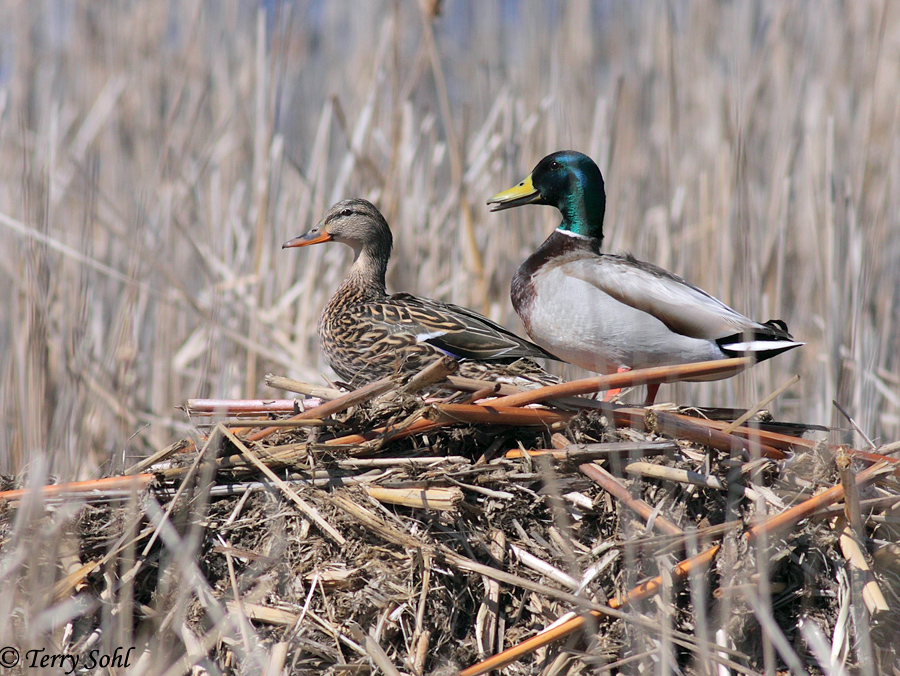 |
 |
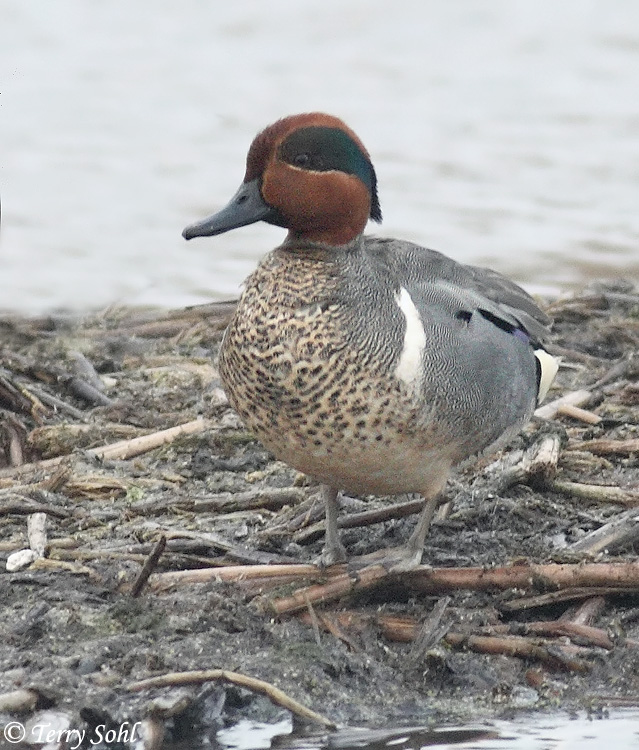 |
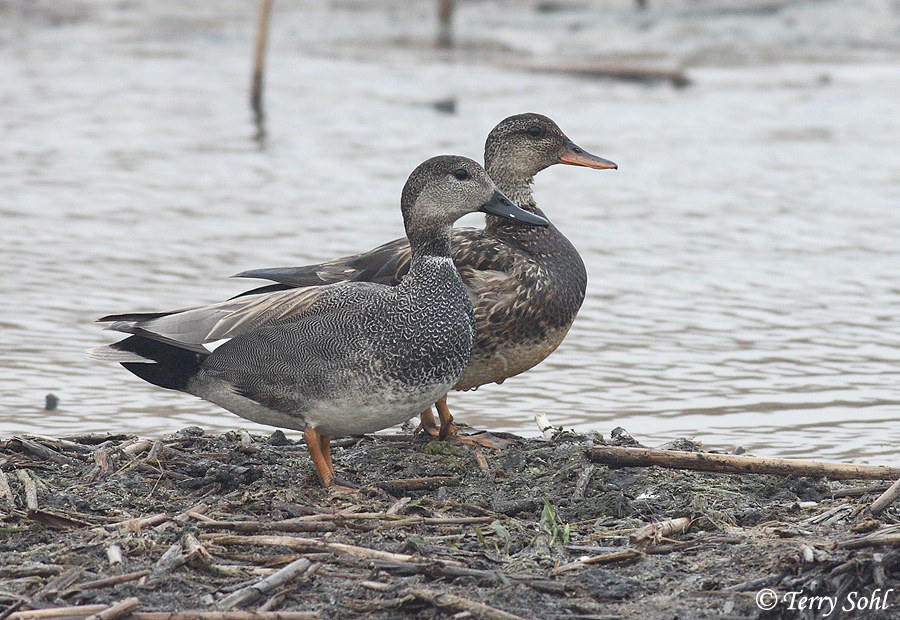 |
| Mallard (pair) | Blue-winged Teal (female) | Green-winged Teal | Gadwall (pair) |
Conservation Status
Observations from Christmas Bird Count and Breeding Bird Survey data show that Northern Shovelers may be declining in recent decades. While one of many duck species hunted in North America, it's primarily habitat loss that's behind local declines. Overall however, Northern Shovelers are found a very broad geographic area, and they are common in many parts of their range. The IUCN currently lists the Northern Shoveler as a species of "Least Concern".
Photo Information
April 4th, 2020 -- Western Minnehaha County -- Terry L. Sohl
Audio File Credits
- 1Peter Boesman, XC218531. Accessible at www.xeno-canto.org/218531
- 2Patrik Aberg, XC112786. Accessible at www.xeno-canto.org/112786

