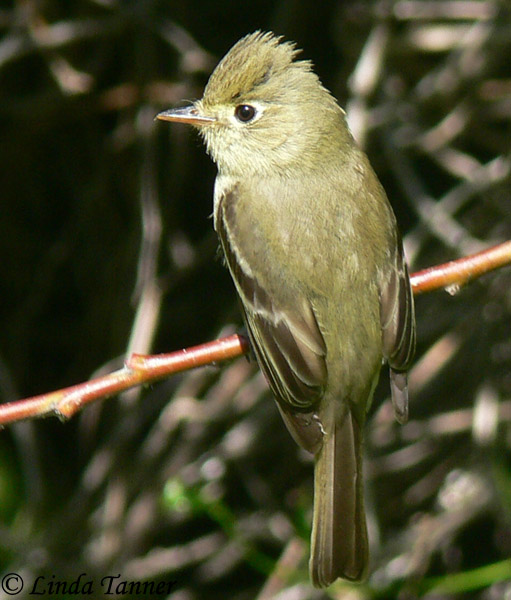
ID Keys: Olive-brown overall plumage for most birds, darker wings
with two white wingbars. Channel Islands birds are grayer.
The
Pacific-slope Flycatcher and the
Cordilleran Flycatcher are virtually identical, and were once considered
one species, the "Western Flycatcher". In appearance, there's very
little to tell the species apart, although the Pacific-slope Flycatcher is
said to be very slightly smaller with a slightly shorter bill. The
easiest way to tell the two species apart is by voice, and by geographic
range.
Habitat
Found in moist forests near the Pacific coast, and while it can be found in areas dominated by conifer forest, they are most commonly found in pockets of deciduous forest.
Diet
Feeds on insects and spiders. They will also occasionally eat berries and seeds.
Behavior
Forages by observing from a perch, and then flying out to capture insects in mid-air, or hovering and gleaning insects from foliage and branches.
Nesting
The nest of a Pacific-slope Flycatcher is an open cup built of mosses, strips of bark, grasses, and leaves, lined with finer vegetative material. The female usually lays 3 or 4 eggs, and she alone incubates them. When the eggs hatch, both parents help to feed the young. The young fledge after about 2 weeks.
Song
Song of a Pacific-slope Flycatcher is a high-pitched series of three phrases... ptsip..seewi...tseet.
Migration
Well-named, the Pacific-slope Flycatcher summers in forests near the Pacific coast. In winter, it is found in western and southern Mexico.
Interactive eBird Map
Click here to access an interactive eBird map of Pacific Slope Flycatcher sightings
Similar Species
C ordilleran Flycatcher
Conservation Status
Populations appear to be decreasing, but they are still found over a wide geographic area and overall populations are not seriously threatened. The IUCN lists the Pacific-slope Flycatcher as a species of "Least Concern".
Photo Information
Photo taken by Linda Tanner - Photo licensed under Creative Commons Attribution 2.0 Generic License.