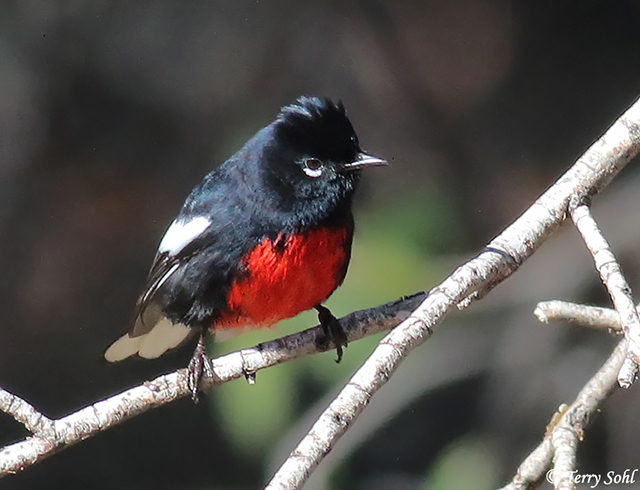
The Painted Redstart is a brilliantly colored bird, with both males and females showing the same brilliant plumage (rare for warbler species). Their primary range is in Mexico and Central America, but the northern extent of their range crosses into Arizona and New Mexico, where they can be locally common. In the U.S. portion of their range, they are primarily found in wooded, higher-elevation canyons and riparian areas. Note that within much of their more tropical range south of the United States, they are known as the Painted Whitestart.
Not a species you'd normally expect to find in South Dakota, a single Painted Redstart was surprisingly seen and photographed in the Pierre area in the fall of 2020. Within days of that sighting Painted Redstarts were also sighted in Minnesota, and New York State.
Habitat
Found in oak and mixed oak and pine forests in the U.S., often in riparian areas.
Diet
Feeds mostly on insects. They will also sometimes come to hummingbird feeders for sugar-water.
Behavior
Very active in foraging, moving quickly through the branches or along the ground. They will sometimes hover and glean insects from foliage while in flight, and will also fly out to capture insects in mid-air.
Nesting
The nest of a Painted Redstart, built by the female, is a small cup of grasses leaves, and other vegetative material. It is placed on the ground, typically in a protected area such as the base of a rock, on a steep slope, or under a bush. The female lays 3 or 4 eggs, and she alone incubates them. Upon hatching, both parents help to feed the young. In many parts of their range, Painted Redstarts will raise two broods a year.
Song
The song of a Painted Redstart is a soft, low-pitched warbling. The call is a sweet cheerup.
- Click here to hear the song of a Painted Redstart1
- Click here to hear the cheer-up call of a Painted Redstart2
- Click here to hear another song of a Painted Redstart3
Migration
Considered a permanent resident throughout much of their range, but those found in the southwestern U.S. are generally migratory, although a few may overwinter in the U.S. Painted Redstarts have rarely wandered far from their normal range, with scattered records throughout many parts of the United States.
Interactive eBird Map
Click here to access an interactive eBird map of Painted Redstart sightings
Similar Species
Painted Redstarts are distinctive if seen well, as they're the only warbler (or any small songbird in range) with the specific combination and pattern of red, white, and black plumage. The few species that could potentially cause some identification challenges under less than ideal viewing conditions include the following:
- American Redstart - American Redstarts are a warbler species with a much broader geographic distribution than the Painted Redstart, and in migration, they could potentially be found in Painted Redstart habitats. Both are black overall with bright offset coloring, but on an American Redstart, the bright color is a rich orange, and it's found on the flank, wings, and tail. American Redstarts also have a white belly, while, the Painted Redstart has a red belly and white on the wings.
- Red-faced Warbler - On the list because it's another warbler species with black and red coloring, the red on a Red-faced warbler is confined to the head and neck, while the red on a Painted Redstart is found on the belly. The black is rather limited on a Red-faced Warbler, with a black back half of the head, and a mostly gray body. That compares to a largely black body on the Painted Redstart.
 |
 |
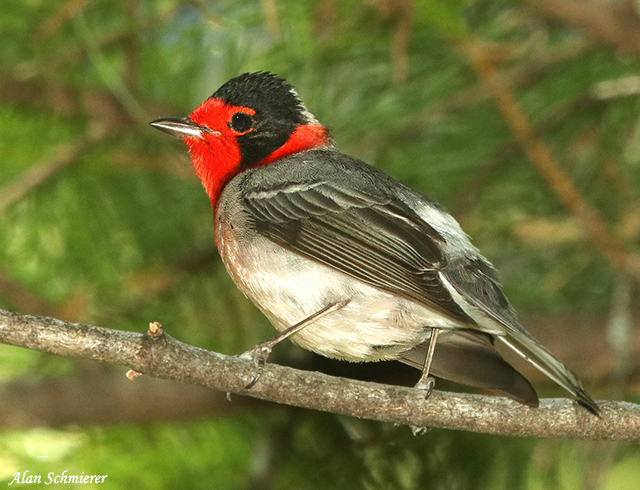 |
| American Redstart | American Redstart | Red-faced Warbler |
Feeders
Painted Redstarts have occasionally come to feeder complexes to feed on offered sugar water at hummingbird feeders.
Conservation Status
Systematic surveys show modest declines in overall Painted Redstart populations in the last few decades. However, they are still found over a relatively broad geographic area, are common in parts of that range, and overall populations aren't under any severe threats. The IUCN lists the Painted Redstart as a species of "Least Concern.".
Photo Information
Photo taken on December 28th, 2018 in Madera Canyon, Arizona - Terry Sohl
Audio File Credits
- 1Manuel Grosselet. Recorded in Oaxaca, Mexico on July 19th, 2020. Original recording and information available from xeno-canto.
- 2Thomas G. Graves. Recorded in Sierra County, New Mexico on August 25th, 2019. Original recording and information available from xeno-canto.
- 3Julia Wittmann. Recorded in Miller Canyon, Cochise County, Arizona on August 19th, 2018. Original recording and information available from xeno-canto.
