
The smallest of the Grebes found in the state, the Pied-billed Grebe is rarely seen in flight. When disturbed or threatened, it prefers to slowly sink and swim away underwater, or move away with just it's head above water. A mature bird in breeding plumage is pictured at the right. Only mature adults in breeding plumage show the dark ring on their bill. Photos of juveniles and winter-plumaged adults can be seen by clicking on the photo links at the bottom of the page.
Habitat
Ponds, lakes, marshes. Usually areas with both heavy marsh vegetation and open water during breeding season, more open water during migration and winter.
Diet
Nearly any small aquatic creature, including fish, insects, frogs, salamanders, snails. Also small amounts of aquatic plants.
Behavior
Foraging is done by diving and swimming underwater in search of prey. Like many grebes, Pied-billed Grebes often eat their own feathers, which are thought to protect the digestive track from sharp or dangerous bits of food. They also form part of regurgitated pellets, cushioning consumed items that cannot be digested.
Nesting
Mid-May. The nest of a Pied-billed Grebe is a cup-shaped platform constructed over open water. The next is built of floating wetland vegetation such as cattails/bulrush, in a location with water that's deep enough (usually a foot or more) to offer some protection from terrestrial predators while offering water deep enough for quick, diving escapes. Both parents help to build the nest, with the female then laying between 2 and 10 eggs. Incubation lasts about 24 days, with both parents helping to incubate the eggs. Upon hatching, the young leave the nest and usually are transported on the backs of the parents for a week or more, before taking to the water themselves, where they continue to be guarded and tended by both parents.
Song
I rarely hear Pied-billed Grebes vocalize. However, they are capable of a variety of vocalizations, including some clucking and chattering calls.
- Click here to hear the laughing/clucking call of a Pied-billed Grebe1
- Click here to hear a quieter short cooing series of calls from a Pied-billed Grebe2
- Click here to hear a honking-like call of a Pied-billed Grebe3
Migration
South Dakota birds migrate in the fall, but birds in the southern U.S. and much of the western U.S. are permanent residents. They are also permanent residents in the Caribbean, Mexico, Central America, and South America.
Interactive eBird Map
Click here to access an interactive eBird map of Pied-billed Grebe sightings
Similar Species
Quite distinctive from most other Grebes in breeding plumage, but if not seen well, or in non-breeding plumage, Pied-billed Grebes could be confused with the following species:
- Horned Grebe - Horned Grebes overlap in range with Pied-billed Grebes in South Dakota, and in their winter/non-breeding plumage (primarily gray tones), they may be confused with a Pied-billed Grebe in non-breeding plumage. However, non-breeding plumage Horned Grebes have white on the breast and face, while Pied-billed Grebes are more uniformly brownish-gray-toned. The bill of a Horned Grebe is thinner than that of a Pied-billed Grebe. Finally the eye of a Horned Grebe is reddish, while the eye of a Pied-billed Grebe is dark.
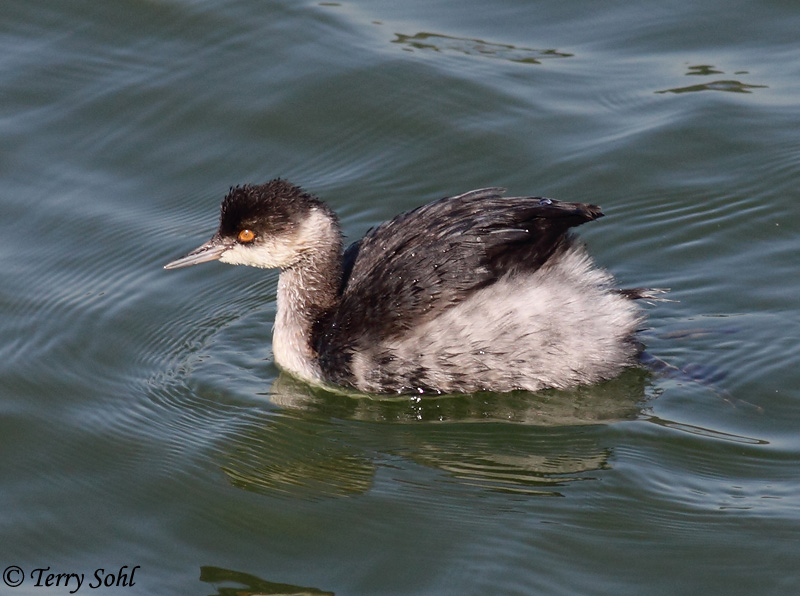
- Eared Grebe - As with Horned Grebes, Eared Grebes are most likely to be confused with Pied-billed Grebes when both are in their winter, non-breeding plumage. In non-breeding plumage, however, Eared Grebes have white on the neck and chin that's lacking from the more uniformly colored Pied-billed Grebe. The bill of an Eared Grebe is considerably slimmer than the more stout bill of a Pied-billed Grebe. As with Horned Grebes, Eared Grebes have a red eye, compared to the dark eye of a Pied-billed Grebe.
- Least Grebe - Least Grebe are a species of extreme southern Texas, Mexico, and Central America, and are not an identification challenge in South Dakota. In range, they can be distinguished from a Pied-billed Grebe by the slimmer bill and obvious yellow eye.
 |
 |
 |
 |
| Horned Grebe | Eared Grebe (non-breeding) | Eared Grebe (breeding) | Least Grebe |
Status
Pied-billed Grebes are found across a very broad geographic area, are common in many parts of their range, and overall population trends are considered stable. The IUCN considers the Pied-billed Grebe to be a species of "Least Concern".
Photo Information
April 11th, 2009 - Dewey Gevik Nature Area, South Dakota -- Terry Sohl
Audio File Credits
- 1Paul Marvin. Recorded in Imperial County, California on January 18th, 2018. Original recording and information from xeno-canto.
- 2Russ Wigh. Recorded in Socorro County, New Mexico on May 7th, 2017. Original recording and information from xeno-canto.
- 3Todd Wilson. Recorded in Dodge County, Wisconsin on June 23rd, 2012. Original recording and information from xeno-canto.
