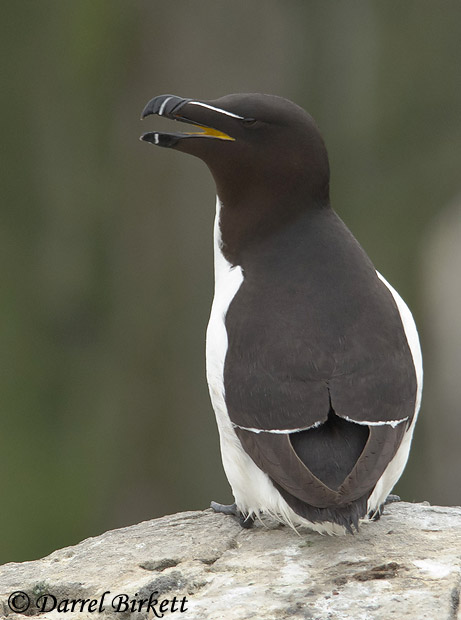
ID Keys: Black above, white below, white line in front of eye, thick
bill with white vertical line
The
Razorbill is a large auk of the North Atlantic, generally similar in
appearance to Murre species found in the same area, but with a decidedly
thicker bill and longer tail. They breed along the coast in southeastern
Canada, and on a few select spots off the coast of Maine, but in winter,
birds can be found along the U.S. coast as far south as Virginia, and
rarely, even further south. The species is also found on the eastern
side of the Atlantic, with the largest population of breeding Razorbills
found in Iceland. They are also found as far east as Russia.
They are typically considered the closest living relative to the
Great Auk, a large extinct auk once found
in the North Atlantic.
Habitat
Nests on rocky areas along the coast, both on offshore islands and on the mainland. Outside of the breeding season, may be found relatively close to shore, to well out to sea.
Diet
Feeds mostly on fish, although they will also sometimes take crustaceans or other small marine creatures.
Behavior
Feeds by swimming underwater, mostly relatively near the surface.
Nesting
Nests in colonies on cliffs, rocky shorelines, or other rocky areas on islands or on the coast. The nest consists of a small pile of pebbles or vegetation, although sometimes no nest is constructed and the egg is laid directly on the ground. One egg is laid, and both parents help to incubate it. Upon hatching, both parents help to feed the youngster.
Song
On their breeding grounds, they make a low, rattling, guttural sound. They are typically silent away from their breeding grounds.
Migration
In the North American part of their range, summers in eastern Canada (Newfoundland, Labrador). Winters offshore, from areas near their breeding grounds, to as far south as Virginia on the U.S. coast.
Interactive eBird Map
Click here to access an interactive eBird map of Razorbill sightings
Similar Species
Common Murre , Thick-billed Murre
Conservation Status
Populations of Razorbills appear to be increasing, and the IUCN lists the Razorbill as a species of "Least Concern".
Photo Information
Photo taken by Darrel Birkett - July 4th, 2010 - Staple Island, Farne - Photo licensed under Creative Commons Attribution 2.0 Generic License .