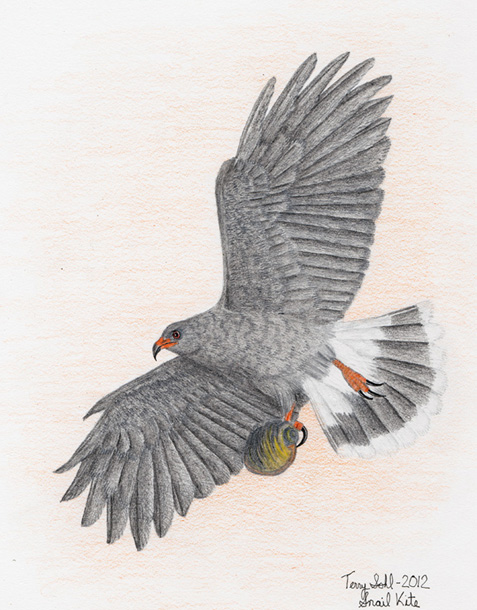
ID Keys: Large, deeply-hooked bill, males gray overall, females
browner with coarse barring underneath.
Hook-billed
Kites are a distinctive resident of Florida, although their range includes
much of Mexico, Central America, South America, and the Caribbean. The
obvious physical feature is the strongly hooked bill, an adaptation that
allows the Snail Kite to extract snails (their main prey) from their shells.
In the U.S., they are considered endangered, as they are highly susceptible
to habitat loss and resultant elimination of their main prey (apple snails).
Disruption of water flow to the Everglades and other parts of Florida have
undoubtedly resulted in a decline in the species over historical levels.
Habitat
Hook-billed Kites prefer shallow,
fresh-water marshes with a mix of open water, wetland vegetation, and
scattered trees or shrubs.
Diet
Feeds almost exclusively on large snails.
In the U.S. portion of their range in Florida, they feed on apple snails.
May also occasionally eat small reptiles, mammals, or crustaceans.
Behavior
Hunting is done by gliding slowly
through wetlands, flying down to snatch snails in flight when they are
spotted.
Nesting
The male builds a nest of sticks and
twigs in a bush or tree, typically over water. Both parents help to incubate
the eggs. After hatching, both parents will tend to the young for the
first several weeks, although one parent then usually departs, leaving the
remaining parent to finish tending to the young.
Song
Usually silent, although they do have a
harsh, long cackling call, as well as other harsh calls.
Migration
Considered a permanent resident
throughout its range. They may make short-term movements in response
to changes in water level and prey abundance.
Globally, the species is
common and widespread, with a broad geographic range and relatively healthy
populations in most of Latin America. However, the species is listed
as endangered in the United States.