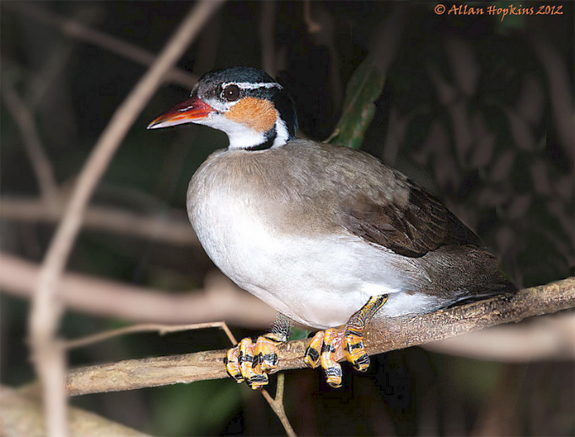
ID Keys: brown upperparts, white underparts, dark crown and nape
with white stripes, white throat, long reddish bill. Female
has buffy cheek patch.
The
Sungrebe may look and sometimes act like grebe species, but they are
actually more closely related to Rail species. They are widespread in
South America, Central America, and southeastern Mexico, but normally are
found several hundred miles from the United States. However, in
November, 2008, a lone Sungrebe was found at Bosque del Apache National
Wildlife Refuge in New Mexico. There was some discussion that the bird
may have been an escapee from captivity, but based on it's shy retiring
behavior and a lack of any obvious banding or other signs of former
captivity, the American Orrnithological Union (AOU) accepted the sighting as
a wild bird. The species thus now occupies a spot on the AOU's
official checklist of birds in the North American region (generally U.S. and
Canada).
The Sungrebe is known for a unique anatomical adaptation in the males.
They have a unique fold of skin under their wings that allows them to
carry young. The Sungrebe, the only member of the Heliornis
genus, is the only bird known to have this adaptation.
Habitat
Found in slow moving streams and rivers,
generally in and around heavy vegetative cover. They are sometime adaptable
to more temporary water sources such as flooded fields and ditches.
Diet
The diet of a Sungrebe is not well
understood, but they are known to feed on molluscs, insects, spiders, small
crabs and other crustaceans, and small reptiles and amphibians.
Behavior
While not a grebe species, they do often
move through the water like a grebe or Anhinga,
with their bodies partially or mostly submerged. They are capable of
strong flight but will often simply slink away through the water rather than
flush and fly away when threatened. Foraging is primarily done at the
surface of the water, picking up food items from the water's surface, just
under the surface, or on nearby vegetation.
Nesting
The nest of a Sungrebe is constructed by
both the male and female. The nest is a platform of sticks and reeds,
lined with leaves, mosses or other material. The nest is placed in
vegetation near a water body, generally quite near the water's surface.
The female lays 2 to 4 eggs, and both the male and female help to incubate
them. Both parents help to raise the young, although the male may care
for them more than the female.
Song
Multiple vocalizations have been heard, from
soft clucking of courting birds, to loud, multi-note calls with rising tones
in the 2nd syllable of each 2-syllable note.
Migration
Considered a permanent resident
throughout their normal range.