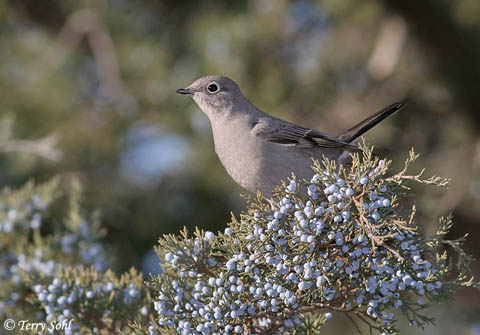
ID Keys: White eye-ring, gray body and head, black tail with white
edging visible in flight
Usually seen alone (as the
name implies), Townsend's Solitaires are best known as winter visitors
throughout most of the state. Individual birds will aggressively defend a
patch of junipers or other sources of berries, with occasionally violent fights
breaking out between two birds.
Habitat
Breeds in open conifer forest, requiring exposed rocky
or dirt areas for nesting on the ground. In the winter, found in woodlands
and shelterbelts, especially around junipers.
Diet
Primarily feeds on insects
in the summer. Primarily feeds on fruits and berries in the winter,
especially juniper berries.
Behavior
In summer, feeds by observing from a
perch, and flying out to catch passing insects in mid-air, or pounce on ones
spotted on the ground. They are also capable of fly-catching,
capturing insects while in flight. Also feeds on berries by climbing
and flitting through foliage.
Nesting
May through July. The nest of a
Townsend's Solitaire is a cup of grasses, rootlets, moss, and other material,
placed on the ground in a protected area, such as the base of a fallen log or
clump of vegetation. The female lays between 4 and 7 eggs, and she does
the majority of the incubation. The young hatch after about 2 weeks.
Lives in all seasons through most of the higher elevation Western U.S.
Extends its range in summer through the Canadian Rockies up into Alaska.
Extends its range in winter by moving to lower elevations in the West, and
moving eastward.