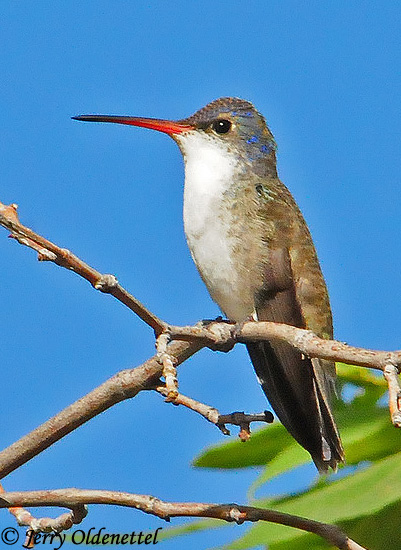
ID Keys: Long red bill, brownish upperparts, white underparts,
violet-colored crown on male
The
Violet-crowned Hummingbird is a fairly distinctive, large hummingbird of
Mexico and the extreme southern part of Arizona and New Mexico. The
species was considered a vagrant in the U.S., but breeding records were
confirmed starting around 1960. Since then, the species has regularly
been found to breed in southern Arizona and New Mexico, primarily in
sycamore trees that line canyon streams. The species has been found
overwintering in the U.S. in greater numbers in recent years, either an
indication of a better observation network, or possibly an indication of an
expansion of range.
Habitat
In the United States portion of their
range, Violet-crowned Hummingbirds are mostly found in riparian areas with
tall trees (especially sycamores and Cottonwoods, with a scrubby understory.
In Mexico, they can be found in a variety of habitats, including dry
shrublands, in pine-oak woodlands, and in suburban gardens.
Diet
Typical diet of hummingbirds, primarily
nectar, but insects also comprise a portion of the diet.
Behavior
Typically follows a series of
established foraging routes, but doesn't strongly defend feeding
territories..
Nesting
The nest of a Violet-crowned Hummingbird
is made of plant fibers bound together with spider webs, lined with downy
plant material, and camouflaged on the outside with lichens, moss, and bark.
Female builds the nest, incubates the eggs, and raises the young.
Song
The call is a thin tak. Song is
a string of high descending syllables.
Migration
Birds in the U.S. and northern Mexico
have long been viewed as primarily migratory, moving to central Mexico in
the winter. Increasing numbers have been discovered overwintering in Arizona
and New Mexico, however. Most birds in the southern two-thirds
of their range are permanent residents.