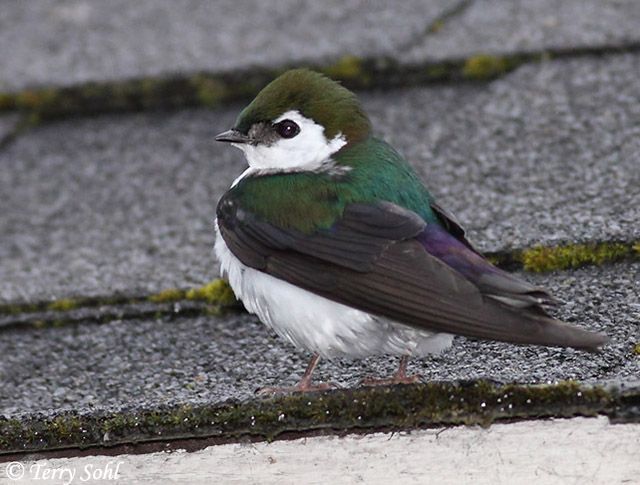
The Violet-green Swallow is a bird of Western North America, and can be found in summer from Mexico all the way up through Alaska. They are similar in appearance and behavior to the Tree Swallow, and sometimes associated very closely with them. In South Dakota, they are found in the far western part of the state, particularly in and around the Black Hills. There, they often nest in and around areas of dead standing timber, including areas that have been impacted by fire, as they use woodpecker cavities in those trees for nesting sites.
Habitat
Violet-green Swallows will use a wide variety of semi-open habitats during the summer nesting season, including canyon walls, pine forests, riparian areas, and tree groves in more open prairie. They prefer forested areas with at least some standing dead timber, as they use cavities in trees for nesting. During migration, they are often found near water (coastlines, rivers, lakes).
Diet
Violet-green Swallows feed almost exclusively on flying insects.
Behavior
Gregarious, Violet-green Swallows often form mixed flocks with other swallows as well as White-throated Swifts. They feed by catching insects in flight, sometimes skimming closely above a water body or the ground in search of prey, or sometimes foraging very high in the sky. Only rarely will they feed on the ground, and typically only when cold weather catches them by surprise and flying insects are scarce.
Nesting
June and July. Violet-green Swallows are cavity nesters, traditionally building their nests in existing tree cavities such as old woodpecker burrows, or cavities in rocky cliffs and crevices. They often nest in small colonies, but typically much smaller than some other swallow species, with just a few dozen nesting pairs at most. A cup is built in the nesting cavity consisting of grasses, weed stems, rootlets, and/or feathers. The female lays between 4 and 6 eggs, and she alone incubates them. Incubation lasts about 12 to 14 days, with the young fledging from the nest about three weeks after hatching.
Song
The most commonly heard vocalizations of a Violet-green Swallow area a thin series of "chee-chee" notes or a chee-dip call.
- Click here to hear the thin calls of a Violet-green Swallow in flight1
- Click here to hear the calls of a juvenile Violet-green Swallow2
- Click here to hear the chattering calls of a Violet-green Swallow in flight3
Migration
Summers throughout the western part of North America, up through southern Alaska. A few winter along the California coast, but most winter in Mexico and Central America. In South Dakota, Violet-green Swallows are common summer residents of the far western part of the state, but migrate southward for the winter.
Interactive eBird map
Click here to access an interactive eBird map of Violet-green Swallow sightings
Similar Species
The plumage of a Violet-green Swallow is unique in color but they could potentially be confused with the following species if not seen well:
- Tree Swallow - A common swallow species with a range the crosses much of the range of the Violet-green Swallow, Tree Swallows and Violet-green Swallows often can be found hanging out together. Tree Swallows have a bluish back and white underparts, compared to the greenish back and purplish shoulder and rump of a Violet-green Swallow. The blue on the Tree Swallow's upperparts also includes the top of the down down through the eye, while the Violet-green Swallow has a white face that extends up and over the eye.
- Barn Swallow - A rather cosmopolitan species with a range that encompasses nearly all of that of the Violet-green Swallow, Barn Swallows are known for their deeply forked tail, compared to the more rounded or squared off tail of a Violet-green Swallow. Barn Swallows are bluish above, while Violet-green Swallows have green and purplish tones. Barn Swallows have a deep bluish head and face with a rusty throat, while Violet-green Swallows have a white face (including above the eye) and a greenish cap.
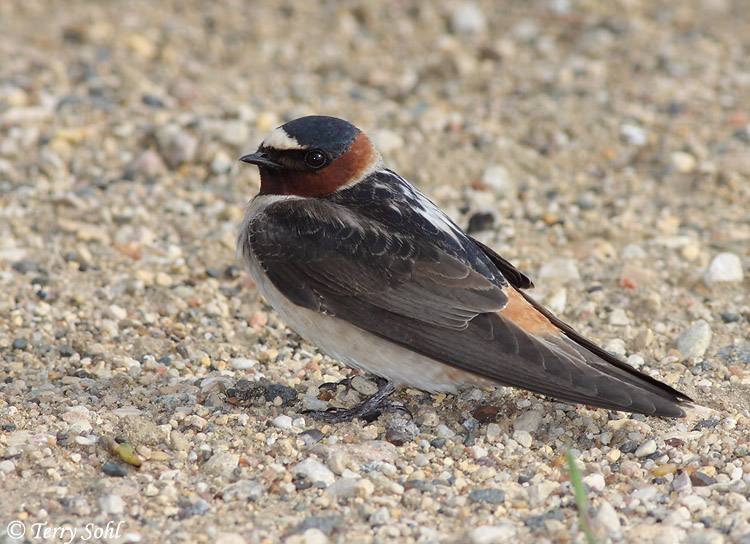
- Cliff Swallow - Cliff Swallows also have a range that encompasses all of that of the Violet-green Swallow. They have a deep bluish back with a buffy colored rump, compared to the deep greenish and purplish tones on the upperside of a Violet-green Swallow. Cliff Swallows also have strong head pattern with a bluish cap that extends down through the eye, a buffy-colored forehead, and a rusty throat. The Violet-green Swallow has a white face and throat and a green cap.
 |
 |
 |
 |
| Tree Swallow | Tree Swallow | Barn Swallow | Cliff Swallow |
Birdhouses
Will readily use man-made nest boxes.
Conservation Status
Numbers are generally stable, although they are in decline in scattered locales due to competition with House Sparrows and European Starlings, and are increasing in other areas due to large numbers of nest boxes. Overall populations are strong, and the are common to abundant in many areas. The IUCN considers the Violet-green Swallow to be a species of "Least Concern".
Photo Information
June 5th, 2009 - Klamath Falls, California - Terry Sohl
Audio File Credits
- 1Richard E. Webster. Recorded in South Hills, Idaho on June 14th, 2018. Original recording and information available from xeno-canto.
- 2Peter Ward. Recorded in Vancouver, British Columbia on July 9th, 1993. Original recording and information available from xeno-canto.
- 3Paul Marvin. Recorded in San Diego County, California on March 15th, 2012. Original recording and information available from xeno-canto.
