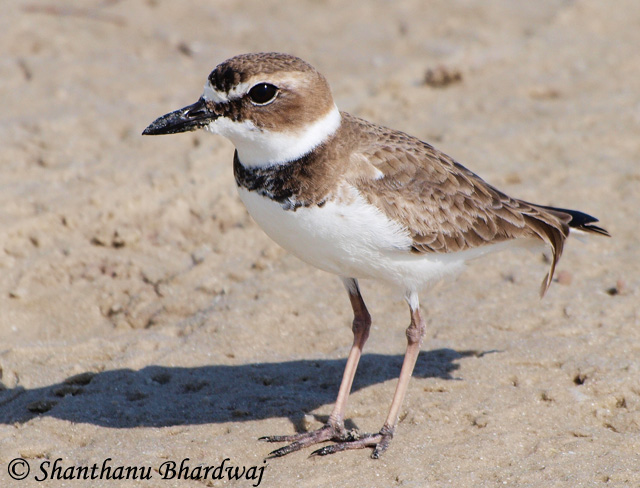
ID Keys: White underparts, throat, and neck band, brownish
upperparts, brownish head with white stripe on brow. Breeding
birds have thick black band across chest, dark forehead.
The
Wilson's Plover is one of several similar plover species found in North
America, but they are distinguished from the
Semipalmated Plover, the
Piping Plover, and the
Snowy Plover by their relatively large
size, their large thick bill (they are sometimes referred to as the
"Thick-billed Plover"), and the complete thick dark band across their chest
when in breeding plumage. They also have a more southerly distribution
than the other similar plover species, as they are usually found only on the
Gulf coast and southern half of the Atlantic coast. Overall
populations are relatively small, but they are not listed nationally as
threatened or endangered. However, some individual states do list the
birds as protected.
Habitat
Found on coastlines with expanses of open
beach or mudflats.
Diet
Feeds on many small marine creatures such as
small crustaceans, mollusks, marine worms, and insects.
Behavior
Forages by running short distances along
the shoreline, stopping briefly to look for food items, and then quickly
making another short move.
Nesting
The Wilson's Plover builds a simple
scrape nest on the beach, lined with small amounts of pebbles, shells, or
beach debris. The female usually lays 3 eggs, and both parents help to
incubate them. After the eggs hatch, both parents help tend to the
young, but the hatchlings leave the nest almost immediately, and they feed
themselves.
Song
The Wilson's Plover has a crisp,
high-pitched kwit flight call. In flight display, they make a
rattling series of notes.
Migration
Wilson's Plovers are generally not
long-distance migrants, and they are considered permanent residents in much
of their range. In the U.S. however, those on the central Atlantic
coast, and many of those on the Gulf coast, move short distances southward
for the winter.