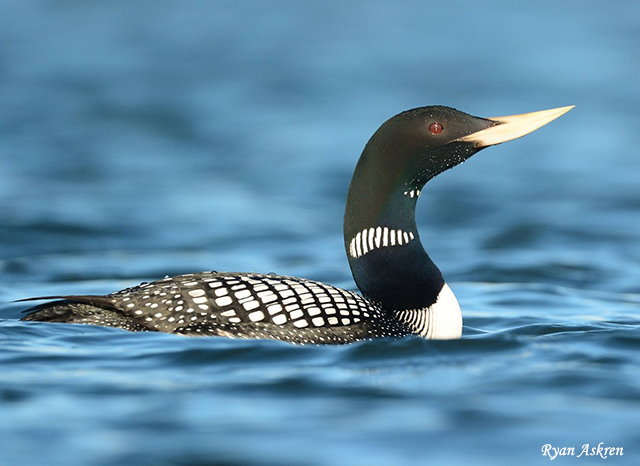
ID Keys: Largest of the loons, thick heavy pale bill, thick neck. Similar
to Common Loon in plumage.
The
Yellow-billed Loon is the largest of the loons, resembling a
Common Loon in plumage but obviously
larger and more heavily built. They are truly a bird of the north,
breeding further north than the other commonly found loons in North America.
In winter, the majority of birds are found in the north Pacific. Only
a few are found as far south as the lower 48 states, and nearly all of those
along the Pacific Coast. Increasingly, however, single birds have been
spotted wintering in the interior of North America. The species was
unknown in South Dakota until a single bird was spotted below Fort Randall
Dam in December 2008. the photo to the right represents a bird in
winter plumage.
Habitat
Breeding grounds are the high Arctic
tundra. Usually winters on the ocean, often near islands, in
bays, or other semi-protected areas. A very few may winter on large
lakes and reservoirs in the interior of the continent.
Diet
Probably feeds primarily on fish, although
the diet of the species is poorly understood. There are some
indications that fledgling will also feed on some plant material.
Behavior
Feeds as do other loons, by diving below
the water's surface and swimming underwater in pursuit of prey, propelled
primarily by their feet.
Breeding
Non-breeder in South Dakota
Song
Similar yodeling or wailing to a
Common Loon, but slower, deeper-pitched,
and more coarse.
Migration
Summers in the high Arctic. Most
winter in the North Pacific, with just a very few birds wintering in the
interior of the continent.
Worldwide population is
likely only 10,000 or less. Although the breeding grounds are far from
most human disturbance, the low total population makes the species
potentially vulnerable to a large oil spill or natural disaster. Given
population declines in recent years,
the IUCN considers the Yellow-billed Loon to be a "Near Threatened" species.
Photo Information
Photo taken by
Ryan Askren - August 12th, 2013 - Bering Land Bridge National Preserve,
Alaska