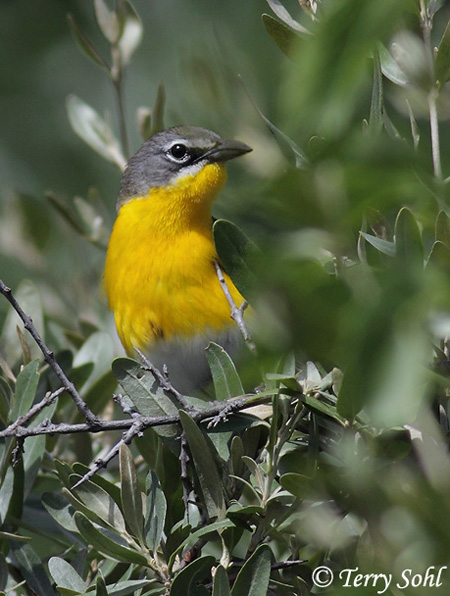
The Yellow-breasted Chat was once considered the largest warbler found in the United States. Recent genetic analysis has brought into doubt whether they truly are warblers, however, and as of 2017, the American Ornithological Society has moved the species to its own family. Its behavior is more like a thrasher or a catbird, as it prefers to hide in dense cover, giving off a sometimes bizarre series of calls. Males are sometimes easier to observe, as they fly over the undergrowth with legs dangling, singing as they go.
Habitat
During breeding season, prefers very brushy thickets, such as those found along streams, woodland and swamp edges, and overgrown pastures.
Diet
Insects, and unlike many warblers, depends heavily on berries and other fruits.
Behavior
Usually forages alone, clambering through brushy thickets in search of insects and berries.
Nesting
June and July. The female builds the nest, constructing a cup of grasses and other plant stems, leaves, strips of bark, and moss, and lines it with finer material including fine grasses, hair, and rootlets. It is placed relatively low to the ground (generally less than 10 feet) in very thick, shrubby vegetation. She incubates the eggs for about 12 days before they hatch. The young fledge from the nest after another 10-12 days.
Song
The song of a Yellow-breasted Chat is an odd mix of cackles and musical phrases.
1Click here to hear the singing of a Yellow-breasted Chat
2Click here to hear another version of a singing Yellow-breasted Chat
3Click here to hear a short cuk call of a Yellow-breasted Chat
Migration
Summers throughout much of the United States. Winters in Mexico and points south. Small numbers, however, do overwinter along the U.S. east coast every year, even as far as New England.
Interactive eBird map
Click here to access an interactive eBird map of Yellow-breasted Chat sightings
Similar Species
Generally distinctive
Bird Feeders
Those that overwinter in the eastern U.S. sometimes come to feeders for suet or peanut butter. Will also sometimes come to feeders for sugar water and nectar, or certain fruits.
Conservation Status
Has declined locally in parts of the Southwest, but has increased its numbers in the Southeast due to brushy habitats created by forest clearing. Overall numbers are generally stable, and there are no perceived systematic threats to the population. The IUCN considers the Yellow-breasted Chat to be a species of "Least Concern".
Photo Information
July 23rd, 2011 - North Cave Hills, Harding County, South Dakota - Terry Sohl
Audio File Credits
1Steve Hampton. Recorded in Yolo County, California on May 8th, 2020. Original recording and information available from xeno-canto.
2Ted Floyd. Recorded in Boulder County, Colorado on July 1st, 2018. Original recording and information available from xeno-canto.
3Richard E. Webster. Recorded in Sonora, Mexico on July 12th, 2006. Original recording and information available from xeno-canto..
