
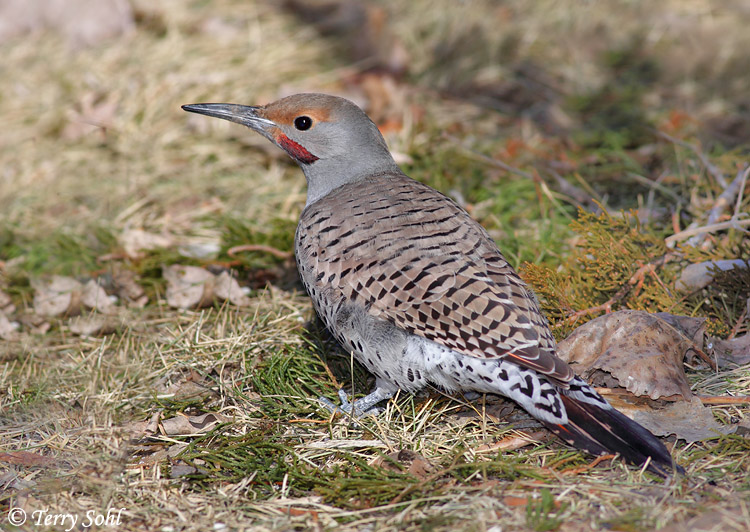
At one time, the Gilded Flicker was considered a subspecies of the similar Northern Flicker, but the two species were split in 1973. The Gilded Flicker does have distinct but subtle plumage differences. In the small area where the ranges of the two species overlap, there is limited interbreeding. Given the former treatment of the species as conspecific with the Northern Flicker, there have been relatively few independent studies of the species. As such, specifics of breeding and other behavior details are not completely understood.
Habitat
Strongly preferred habitat are deserts of the Sonoran Desert with saguaro cactus that are used for nesting. They will also less frequently use riparian zones with large trees.
Diet
The Gilded Flicker feeds primarily on ants and other insects gathered from the ground, including beetles, termites, and their larvae. It also eats fruits, berries, and seeds, particularly those of desert plants such as saguaro cactus and other native cacti.
Behavior
Most foraging is done on the ground. There, they walk along, stopping to dig in the soil with their bills as they search for ants, or glean insects from the ground or vegetation when spotted.
Nesting
The nest is a cavity built by excavating a hole in a saguaro cactus, or less often, in a large tree in a riparian zone (such as a cottonwood). No materials are used to augmented the nesting cavity, as eggs are laid directly on the floor of the cavity. The female lays between 3 and 5 white eggs. Both the male and female help to incubate the eggs, with incubation lasting about 12 days. The young fledge from the nest after about 25 days, but parents and young still remain in contact for another couple of weeks until the young become fully independent.
Song
Has a long wika-wika-wika-wika call, as well as a crying kyeer call. The song is a very audible and long kik-kik-kik-kik-kik.
- Click here to hear the kyeer call of a Gilded Flicker1
- Click here to hear the kik-kik-kik-kik song of a Gilded Flicker2
- Click here to hear the wika-wika-wika calls of a Gilded Flicker, along with a bit of drumming3
Migration
Considered a permanent resident throughout its range, with only short local movements of most populations.
Interactive eBird map
Click here to access an interactive eBird map of Gilded Flicker sightings
Similar Species
There are a couple of other similarly sized woodpecker species that could be confused with a Gilded Flicker.
- Northern Flicker - Both Northern Flickers and Gilded Flickers have quite similar plumage patterns, with a few key differences. The Northern Flicker has both a "Red-shafted" and "Yellow-shafted" form, but Yellow-shafted forms are found in the eastern US and don't overlap in range with Gilded Flickers. Red-shafted Northern Flickers have a similar facial pattern, with a gray face and tan crown, and males of both species have a red "mustache" stripe. However, the tan crown on Gilded flicker is consistent and broader, extending to the back of the head, while that of a Northern Flicker is less extensive and found primarily on the forehead. Red-shafted Northern Flickers also have an obvious salmon color under their wings and tail, most obvious in flight, while those of a Gilded Flicker are yellow. Both species have black-spotted underparts against a lighter background color, but that of a Northern Flicker tends to be "warmer" in color with more brown tones, while that of a Gilded Flicker has more grayish tones.
- Gila Woodpecker - The "other" similarly sized, saguaro-nesting woodpecker in the range of the Gilded Flicker, Gila Woodpeckers may be superficially similar but have quite different plumage patterns. The Gila Woodpecker has black-and-white horizontal barring on its back with both colors of roughly equal proportion, while the back of a Gilded Flicker is tannish in color with black horizontal barring that is less bold than the black on a Gila Woodpecker. The underside of a Gila Woodpecker is a plain tan, while that of a Gilded Flicker is heavily spotted against a grayish background. The head of a Gila Woodpecker has a simpler pattern, with an all-tannish color. Males have a red spot on their forehead.
 |
 |
 |
 |
| Northern Flicker (Red-shafted, male) | Northern Flicker (Red-shafted, female) | Gila Woodpecker (male) | Gila Woodpecker (male) |
Feeders
They will sometimes attend feeders for offered fruits.
Conservation Status
Local loss of habitat has hurt the species in some locations, with overall populations declining compared to historical levels prior to 1900. In recent decades, the Breeding Bird Survey and Christmas Bird count records indicate rather sharp declines, of 50% or more in the last 40 years. However, they are still relatively common in parts of their range, and overall numbers currently aren't considered to be a major concern. The IUCN lists the Gilded Flicker as a species of "Least Concern".
Further Information
- eBird - Gilded Flicker
- Audubon Field Guide - Gilded Flicker
- Cornell Lab of Ornithology - All About Birds: Gilded Flicker
Photo Information
Photo taken on May 8th, 2008 - Outskirts of Tucson, Arizona - Terry Sohl
Audio File Credits
- 1Bobby Wilcox - Recorded in Penal County, Arizona on July 28th, 2019. Original recording and information available from xeno-canto.
- 2Andrew Spencer - Recorded in Pima County, Arizona on February 22nd, 2008. Original recording and information available from xeno-canto.
- 3Richard E. Webster - Recorded in Baja California on March 4th, 2001. Original recording and information available from xeno-canto.
